
Did you know that people in the US have been getting shorter since roughly the 1980s, a solid indicator of diminished access to nutrition, and that this trend continued under the Biden administration?
theweek.com/health/height-in-a…
Did you know that homelessness went up during his presidency?
bbc.co.uk/news/articles/cx2vwd…
Deaths of despair from overdoses and suicides, too.
nida.nih.gov/research-topics/t…
abcnews.go.com/amp/Health/numb…
Something is catastrophically broken in the US.
1/
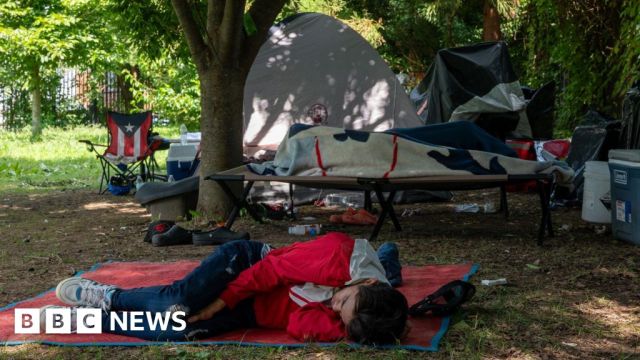
US homelessness hit record high in 2024
High housing costs, natural disasters and a spike in migration helped fuel the rise, officials said.Mike Wendling (BBC News)
reshared this
HeavenlyPossum
in reply to HeavenlyPossum • • •This does not mean that I am accusing Biden of having caused these trends, or even of having failed to try to fix them. I think he did, in his own way.
But Biden saw his mission as attempting to restore a status quo-ante that was already grinding people up into slurry. It was already broken by repair. I don’t know that he saw himself as trying to make things worse, but anything short of total revolution was going to be inadequate to address a system that is making us smaller, homeless, and more likely to annihilate ourselves.
brown.edu/news/2025-04-02/weal…
2/
Even the richest Americans face shorter lifespans than their European counterparts, study finds
Brown UniversityBeverley reshared this.
HeavenlyPossum
in reply to HeavenlyPossum • • •There’s an ongoing debate among online US liberals and lefty types about just how good or bad the economy was during Biden’s term in office.
The liberal faction largely argues that things were actually pretty good, since real wages—that is, wages that account for inflation—went up during Biden’s tenure. The fact that so many people reported negative attitudes towards the economy, then, must be the product of negative media coverage. This is the “vibecession” thesis, the idea that people are too stupid to accurately assess their economic circumstances and were tricked into refraining from voting for Biden and Harris.
Alternatively, perhaps people have gotten used to having access to so much amazing *stuff* that even a slight interruption to this flow of treats is experienced as a decline in living standards. That is, you don’t lose anything, but perhaps you have more difficulty acquiring yet more stuff. This is the “hedonic treadmill” thesis.
... show moreThere’s an ongoing debate among online US liberals and lefty types about just how good or bad the economy was during Biden’s term in office.
The liberal faction largely argues that things were actually pretty good, since real wages—that is, wages that account for inflation—went up during Biden’s tenure. The fact that so many people reported negative attitudes towards the economy, then, must be the product of negative media coverage. This is the “vibecession” thesis, the idea that people are too stupid to accurately assess their economic circumstances and were tricked into refraining from voting for Biden and Harris.
Alternatively, perhaps people have gotten used to having access to so much amazing *stuff* that even a slight interruption to this flow of treats is experienced as a decline in living standards. That is, you don’t lose anything, but perhaps you have more difficulty acquiring yet more stuff. This is the “hedonic treadmill” thesis.
web-cdn.bsky.app/profile/ceroe…
3/
@ceroespada.bsky.social
@ceroespada.bsky.social (Bluesky Social)Beverley reshared this.
HeavenlyPossum
in reply to HeavenlyPossum • • •As best as I can tell, real wages did begin to grow in excess under Biden—by a little bit, towards the end of his term in office.
statista.com/chart/amp/27610/i…
Is that wage growth sufficient to compensate workers for all the trillions of dollars that were transferred from poor to rich during that period of inflation? Of course not—but that’s largely beside the point.
Which is: wealth and poverty are a social relationship of command, not just a measure of how much “stuff” a person has. And being subject to that relationship of command can be debilitating in ways that can’t be measured in simple wages and price indices.
4/
Real Wages Rise Again as Wage Growth Outpaces Inflation
Felix Richter (Statista)Beverley reshared this.
HeavenlyPossum
in reply to HeavenlyPossum • • •We know that poverty is the condition of being precariously subject to the commands of others because poverty has real, observable, material effects on our health and life expectancy that cannot be explained simply by lifestyle differences (smoking, alcohol consumption, etc) or unequal access to health amenities (healthy food, clean air, exercise opportunities, medical treatment, etc).
“Poverty is strongly associated with increased risk of death, but the risks could be modestly abated by a healthier lifestyle.”
pmc.ncbi.nlm.nih.gov/articles/…
“…this risk [of cardiovascular disease] was even greater in more deprived groups when lifestyle was measured by an extended score that included emerging factors than by a traditional score. These inequalities in lifestyle-related risk were not accounted for by differences in sex, age, ethnicity, blood pressure, concurrent cholesterol or blood pressure medication, or body-mass index.
... show moreWe know that poverty is the condition of being precariously subject to the commands of others because poverty has real, observable, material effects on our health and life expectancy that cannot be explained simply by lifestyle differences (smoking, alcohol consumption, etc) or unequal access to health amenities (healthy food, clean air, exercise opportunities, medical treatment, etc).
“Poverty is strongly associated with increased risk of death, but the risks could be modestly abated by a healthier lifestyle.”
pmc.ncbi.nlm.nih.gov/articles/…
“…this risk [of cardiovascular disease] was even greater in more deprived groups when lifestyle was measured by an extended score that included emerging factors than by a traditional score. These inequalities in lifestyle-related risk were not accounted for by differences in sex, age, ethnicity, blood pressure, concurrent cholesterol or blood pressure medication, or body-mass index.”
sciencedirect.com/science/arti…
“These findings are consistent with the vulnerability hypothesis, suggesting that the same risk factors are more harmful for people living in deprived circumstances than for people living in affluent areas.”
thelancet.com/journals/lanpub/…
Poverty literally changes the physical structure of our brains:
“Our findings reveal income inequality as a unique societal-level determinant of neurodevelopment and mental health, independent of individual socioeconomic status.”
nature.com/articles/s44220-025…
5/
Macroeconomic income inequality, brain structure and function, and mental health - Nature Mental Health
NatureBeverley reshared this.
HeavenlyPossum
in reply to HeavenlyPossum • • •A person in poverty doesn’t just have “less stuff,” but also lives at the precarious command of the wealthy.
Most people in the US are aware, on some level, that in some financial market thousands of miles away from them, some anonymous finance bro might casually make a gamble that cripples entire sectors of the economy and potentially costs them their job, their income, their heath care, their ability to feed their family, their home, their community, and their status as a dignified member of that community.
theguardian.com/world/2009/nov…
6/
How Detroit, the Motor City, turned into a ghost town
Paul Harris (The Guardian)Beverley reshared this.
HeavenlyPossum
in reply to HeavenlyPossum • • •We know, definitively, that chronic stress has a major negative effect on our health…
(pmc.ncbi.nlm.nih.gov/articles/…)
…and poverty entails constant, grinding stress.
Wages and income are of course important factor for understanding economic well-being, but an approach that treats economic well-being as a synonym for *stuff* misses the social aspect of the US (and any) economy. How much do you control your own economic choices? How confident are you that your economic choices have a meaningful effect on your economic outcomes?
The answer for most Americans is “none or very little.”
7/
The effects of chronic stress on health: new insights into the molecular mechanisms of brain–body communication - PMC
pmc.ncbi.nlm.nih.govBeverley reshared this.
HeavenlyPossum
in reply to HeavenlyPossum • • •Humans are distinctly social animals. When humans are kept in isolation, we experience declining mental and physical health, irreversible cognitive changes, and, eventually, death.
We cannot separate the social from the material. Our social standing has a direct effect on our material well-being. This isn’t something we can casually dismiss by pointing to *relative* poverty, as if it’s ok to be poor compared to Elon Musk because we have access to YouTube. People who live in egalitarian communities, even ones that have so much less *stuff* than ours, seem to experience less of the stress that drives our high rates of self-harm:
researchgate.net/publication/3…
And so the rampant, growing, and obscene inequality in the US isn’t just turning the economy into a giant scam factory and encouraging people to check out from electoral politics. It is literally, physically, materially killing us.
8/
Beverley reshared this.
HeavenlyPossum
in reply to HeavenlyPossum • • •So did real wages actually increase under Biden? Yes, it seems they did, by a bit, towards the end.
And does that contradict peoples’ general assessment of the economy as bad in some way? No, not at all.
People were still dying earlier, and harming themselves more frequently, and losing their homes, and birthing shorter children all through Biden’s administration, because the processes of late stage capitalism exceed the grasp of any presidential administration.
This doesn’t explain Trump’s re-election, because Trump is simply accelerating the destruction of the US working class. But it does help explain the public’s discontent with an economy that appears, to some pundits, to have been quite good because people had treats.
9/
Beverley reshared this.
HeavenlyPossum
in reply to HeavenlyPossum • • •Part of me can’t help but wonder how much we can attribute to the realization in 2020, by many Americans, that the economy really could be structured otherwise and the collective power of the public really could be mobilized—even if just by the US government—to make lives better.
From direct stimulus payments to child tax credits to freezes on rental evictions and student debt, people were introduced to the idea that the federal government could just *shut off* so many of the extractive and impoverishing mechanisms of late stage capitalism.
And then, under Biden, in order to “get back to normal,” all of that went away.
cbpp.org/research/poverty-and-…
So perhaps as everyone was being robbed via inflation, at least the inkling of an idea might have occurred to people that the state could have, but chose not to, help them.
10/
reshared this
Beverley reshared this.
HeavenlyPossum
in reply to HeavenlyPossum • • •To sum up:
Real wages did actually grow under Biden.
But deep, structural problems that aren’t measured by metrics like wages continued to wear down Americans.
This doesn’t mean Biden is to blame or that Trump deserved somehow to win, but it’s absurd to dismiss Americans’ real economic anxieties as the product of being stupidly bamboozled by the media.
Ultimately, it is the inequality that defines late stage capitalism in the US that is literally killing us. This is what it is like to live through the collapse of a global system.
11/
HeavenlyPossum
in reply to HeavenlyPossum • • •This was all supposed to be a much more coherent thread than it turned out to be, but Metatext ate it *twice* while I was writing it, so it ended up being a little slapdash.
If you enjoyed it anyway, and can, I always appreciate your support:
buymeacoffee.com/HeavenlyPossu…
Many thanks to everyone who has donated, and many thanks to everyone else just for reading, commenting, and sharing.
12/end
The Great Llama
in reply to HeavenlyPossum • • •FoolishOwl
in reply to HeavenlyPossum • • •There's an argument that "luxury" items have become cheap relative to necessities. It's a lot easier to see a movie now then it was in the 70s, for instance. But, housing, education, and medical care have become incredibly expensive.
So people feel guilty about comforting themselves with movies when they're worried about losing their apartment, for instance.
This is complicated by the cultural memory of it being the other way around.
Violet Madder
in reply to HeavenlyPossum • • •The "stuff" that occupies my ambitions is shit like, can I get some pants that actually fit and shoes that don't have holes in them, can I call a ride if I miss the last bus or will I have to walk miles to get home in the dark, can I get healthy food, etc. More advanced stuff like a working computer, my own vehicle, my own room to live in-- those are pie in the sky decadence.
Recreation and hedonic treadmills have been very out of reach for quite a while now.
When inflation goes up, the rich don't feel it. They still hold the same positions, relative to each other, on the big fat scoreboard that is all wealth means for people whose basic needs are already met.
A drop or two of inflation is all it takes to double my grocery bill and nuke my ability to eke out the tiny savings I had from food stamps each month. All they have to do is squeeze to erase our paltry margins of safety.
Simon Brooke reshared this.
visikde
in reply to HeavenlyPossum • • •The Senator from Dupont was all about legacy
The presidency was the pinnacle of his political career. the allure was so strong he quickly forgot his pledge to only serve one term.
Kamala was a failed candidate in 2020, no where near a front runner, an expedient choice that pleased the donor class