I had the opportunity to work with the team at OpenBeta on the re-launching of their community forums. They're one of our earliest v4 testers, since they've agreed to have ActivityPub enabled!
(Okay, more realistically I dragged them into it kicking and screaming, but they did provide the opportunity for the forum relaunch, so I'm taking the opportunities as they come!)
During the prep, I discussed some of the well-trodden concept of the fediverse to my co-admin, Ben (@bean@community.openbeta.io and also @bean@uvix.cc)... stuff I'm sure you've come across:
Fragmented nature of conversations
The idea of an instance
Content discovery with respect to the follow-relationship model
... and wouldn't you know it, it's really hard to discuss these ideas, and Ben is actually fairly well-versed! He ran his own Iceshrimp instance, so all of this wasn't exactly new to him.
Part of it was that I had been steeped in the ActivityPub dev scene for almost a year, so
... show more
I had the opportunity to work with the team at OpenBeta on the re-launching of their community forums. They're one of our earliest v4 testers, since they've agreed to have ActivityPub enabled!
(Okay, more realistically I dragged them into it kicking and screaming, but they did provide the opportunity for the forum relaunch, so I'm taking the opportunities as they come!)
During the prep, I discussed some of the well-trodden concept of the fediverse to my co-admin, Ben (@bean@community.openbeta.io and also @bean@uvix.cc)... stuff I'm sure you've come across:
Fragmented nature of conversations
The idea of an instance
Content discovery with respect to the follow-relationship model
... and wouldn't you know it, it's really hard to discuss these ideas, and Ben is actually fairly well-versed! He ran his own Iceshrimp instance, so all of this wasn't exactly new to him.
Part of it was that I had been steeped in the ActivityPub dev scene for almost a year, so it's hard to step back and explain to ~~mere mortals~~ ~~laymen~~ non-developers what exactly all this ActivityPub nonsense is.
All I know it gets me thinking that I need to work with @andypiper@macaw.social on documentation!
Documentation is absolutely an essential part of it, but I think it might be worth stepping back a bit more and acknowledging that "needs more documentation" is still a techie response to this challenge.
What the Fediverse needs is a good PR person lol. It needs communication, not documentation. Communication is relating ideas to laymen and showing them why Fedi is exciting for them, not just why it's technically cool or how it works.
One of the central concepts to the Fediverse is the abstraction between content and presentation. That's really what it's all about: my instance is responsible for presentation, but the content can be viewed anywhere. And the problem is that people don't get how a Facebook post could be a Tweet. And even if they can get that, it's more confusing how a Reddit post could be an Instagram post.
For this to work and to at least get users onboard in the first place -- and I think NodeBB does a great job of this overall -- Fedi platforms need to be transparent to users. NodeBB needs to just work as a forum for forum us
... show more
Documentation is absolutely an essential part of it, but I think it might be worth stepping back a bit more and acknowledging that "needs more documentation" is still a techie response to this challenge.
What the Fediverse needs is a good PR person lol. It needs communication, not documentation. Communication is relating ideas to laymen and showing them why Fedi is exciting for them, not just why it's technically cool or how it works.
One of the central concepts to the Fediverse is the abstraction between content and presentation. That's really what it's all about: my instance is responsible for presentation, but the content can be viewed anywhere. And the problem is that people don't get how a Facebook post could be a Tweet. And even if they can get that, it's more confusing how a Reddit post could be an Instagram post.
For this to work and to at least get users onboard in the first place -- and I think NodeBB does a great job of this overall -- Fedi platforms need to be transparent to users. NodeBB needs to just work as a forum for forum users, and any topics posted there need to just work as a post for Mastodon users, just work as a topic for Lemmy users, etc.
As an example as the disconnect between the thread on Nodebb and Discourse, @bumblefudge@socialhub.activitypub.rocks 's post is missing from nodebb sites thread.
And conversley some of Ceasars posts are in this thread but not that one. Isnt the goal to duplicate all posts in all places so they stay in sync?
The lack of complete federation is another very good (and very hard to solve) point that makes federation less-than-intuitive. From my Mastodon instance the situation is worse, none of @bumblefudge 's posts nor any others from SocialHub appear in the thread. (See indieweb.social/@julian@commun…)
I suspect most of the federation problems mentioned in the last few posts are the "fault" of Discourse – BrowserPub fails to find anything at browser.pub/socialhub.activity… – but in the end the user doesn't care whose fault it is when something doesn't work, they just think federation is confusing and broken.
The film follows the assassination of Kim Jong-nam, as he is assassinated by two young women who were tricked and thought they were participating in a prank show.
Åtal för förberedelse till mord. Åklagare väckt åtal vid Attunda tingsrätt mot 20 personer för inblandning i mordplaner i Upplands Väsby under vintern 2023.
Sillen i Östersjön och Bottenhavet är inte i någon som helst fara för att bli utrotad. EU:s beslut om kvoterna följer forskarnas rekommendationer. Forskarna i detta fall är 100-tals forskare från en mängd länder som ligger bakom råden från Internationella Havsforskningsrådet (ICES).
Polsk lastbil fraktade 129 200 tramadoltabletter. Föraren påstod vid kontrollen att han skulle frakta byggmaterial till sin pappas firma i Sverige. Men tulltjänstemännen tyckte att mannen uppträdde märkligt och började genomsöka hans fordon. I bilen hittades två kartonger som visade sig innehålla Tramadol.
The AGM-158 JASSM (Joint Air-to-Surface Standoff Missile) is a low detection standoff air-launched cruise missile developed by Lockheed Martin for the United States Armed Forces.[7] It is a large, stealthy long-range weapon with a 1,000-pound (450 kg) armor piercing warhead.
Depending upon whether it's the -ER variant (extended range) or not:
The UX is probably the best thing about it. Better than anything else by a long shot. I really wish others would catch up and abandon the Windows 95 UX. They're just so clunky and stuck in the past.
Yeah, gnome seems to be something you either hate or love.
Admittedly I haven't used Gnome that much (because I don't like it) but I'm in the former group, I can't stand the UI and the UX sucks for me. Gnome really feels clunky and like change for the sake of change.
I really like KDE though. I'm also not a fan of MacOS and especially not the way they take out the menus in programs and force it to be OS integrated. I really really hate that. The program should stay inside the program and not invade my OS.
Åklagare har väckt åtal för mord i Fittja på en 27-årig man. Han sköts till döds på en restaurang i Fittja söder om Stockholm den 21 mars i år. Tre personer har åtalats.
Vi har alla läst dem. Domedagsartiklarna om att antalet insekter minskar. Det visar sig att det inte stämmer. Inte i Sverige i alla fall. För antalet insekter minskar inte i Sverige. Det visar en genomgång som SLU gjort. De har tittat på data från fyra olika platser i Sverige där det finns material från sugfällor sen 35 år tillbaka.
Två norrmän gripna för narkotikasmuggling. I tisdags greps två norska medborgarna i Colombia. De greps i en internationell polisinsats som har letts av den spanska polisen. Insatsen som går under beteckningen Mentor har pågått sedan juni 2020 och 11 länder har deltagit.
– Vi levererar nu ett pärlband av beslut för att bana väg för ny kärnkraft. Näringsminister Ebba Busch Ett av dessa ”pärlor” för nya kärnkraftverk kan bli en enorm statlig satsning enligt förslag i en utredning som presenterades i måndags.
Enligt förslaget i utredningen ska staten låna upp minst 300 miljarder kronor för fyra […]
– Vi levererar nu ett pärlband av beslut för att bana väg för ny kärnkraft. Näringsminister Ebba Busch Ett av dessa ”pärlor” för nya kärnkraftverk kan bli en enorm statlig satsning enligt förslag i en utredning som presenterades i måndags.
A while ago, someone e-mailed me with a request to add Flatpak to my repository. At the time, I had no interest in Flatpak, had not actually bothered to investigate it, so I said “sorry, no…
Yes, you can be against it philosophically all you want, but the fact that most of the software you need is now available for easy installation on any distro is pretty awesome. And IMO, it puts the Slack back into Slackware. It's supposed to be a distro for lazy people.
Jesper Nilsson har skrivit en intressant reflektion över vänstermedier som kan se som en slags reaktion eller kommentar till mitt blogginlägg om vänstermedias kräftgång. De centrala budskapen i hans artikel är att vänstermedia misslyckas på grund av omvärlden (mer specifikt på grund av den svaga vänstern) och att statistik inte är att lita på. Utan […]
I don’t consider myself exceptional in any regard, but I stumbled upon a few cryptography vulnerabilities in Matrix’s Olm library with so little effort that it was nearly accidental.
It should not be this easy to find these kind of issues in any product people purportedly rely on for private messaging, which many people evangelize incorrectly as a Signal alternative.
Later, I thought I identified an additional vulnerability that would have been much worse, but I was wrong about that one. For the sake of transparency and humility, I’ll also describe that in detail.
I don’t consider myself exceptional in any regard, but I stumbled upon a few cryptography vulnerabilities in Matrix’s Olm library with so little effort that it was nearly accidental.
It should not be this easy to find these kind of issues in any product people purportedly rely on for private messaging, which many people evangelize incorrectly as a Signal alternative.
Later, I thought I identified an additional vulnerability that would have been much worse, but I was wrong about that one. For the sake of transparency and humility, I’ll also describe that in detail.
Many people have, over the years, assumed the opposite and commented accordingly. The ensuing message board threads are usually is a waste of time and energy for everyone involved. So please adjust your expectations.
2024-05-15: I took a quick look at the Matrix source code. I identified two issues and emailed them to their security@ email address. In my email, I specify that I plan to disclose my findings publicly in 90 days (i.e. on August 14), in adherence with industry best practices for coordinated disclosure, unless they request an extension in writing.
2024-05-16: I checked something else on a whim and find a third issue, which I also email to their security@ email address.
2024-05-17: Matrix security team confirms receipt of my reports.
2024-05-17: I follow up with a suspected fourth finding–the most critical of them all. They point out that it is not actually an issue, because I overlooked an important detail in how the code is architected. Mea culpa!
2024-05-18: A friend discloses a separate finding with Matrix’s protocol. (Will update this to link to their write-up once it’s public.) They instructed the Matrix developers to consult with me if they needed cryptography guidance. I never heard from them on this externally reported issue.
2024-07-12: I shared this blog post draft with the Matrix security team while reminding them of the public disclosure date.
2024-07-31: Matrix pushes a commit that announces that libolm is deprecated.
2024-07-31: I email the Matrix security team asking if they plan to fix the reported issues (and if not, if there’s any other reason I should withhold publication).
2024-07-31: Matrix confirms they will not fix these issues (due to its now deprecated status), but ask that I withhold publication until the 14th as originally discussed.
2024-08-14: This blog post is publicly disclosed to the Internet.
As of 2009, you could remotely detect a timing difference of about 15 nanosecond over the Internet with under 50,000 samples. Side-channel exploits are generally statistical in nature, so such a sample size is generally not a significant mitigation.
How is this code actually vulnerable?
In the above code snippet, the vulnerability occurs in aes_sbox[/* ... */][/* ... */].
Due to the details of how the AES block cipher works, the input variable (word) is a sensitive value.
Software written this way allows attackers to detect whether or not a specific value was present in one of the processor’s caches.
To state the obvious: Cache hits are faster than cache misses. This creates an observable timing difference.
Such a timing leak allows the attacker to learn the value that was actually stored in said cache. You can directly learn this from other processes on the same hardware, but it’s also observable over the Internet (with some jitter) through the normal operation of vulnerable software.
The correct way to solve this problem is to use hardware accelerated AES, which uses distinct processor features to implement the AES round function and side-steps any cache-timing shenanigans with the S-box.
Not only is this more secure, but it’s faster and uses less energy too!
Signature malleability usually isn’t a big deal for most protocols, until suddenly you discover a use case where it is. If it matters, that usually that means you’re doing something with cryptocurrency.
Briefly, if your signatures are malleable, that means you can take an existing valid signature for a given message and public key, and generate a second valid signature for the same message. The utility of this flexibility is limited, and the impact depends a lot on how you’re using signatures and what properties you hope to get out of them.
For ECDSA, this means that for a given signature , a second signature is also possible (where is the order of the elliptic curve group you’re working with).
Matrix uses Ed25519, whose malleability is demonstrated between and .
This is trivially possible because S is implicitly reduced modulo the order of the curve, , which is a 253-bit number (0x1000000000000000000000000000000014def9dea2f79cd65812631a5cf5d3ed) and S is encoded as a 256-bit number.
The Ed25519 library used within Olm does not ensure that , thus signatures are malleable. You can verify this yourself by looking at the Ed25519 verification code.
Any C library that handles base64 codecs for private key material should use a similar implementation. It’s fine to have a faster base64 implementation for non-secret data.
Most Matrix clients that still depended on libolm should treat this blog as public 0day, unless the Matrix security team already notified you about these issues.
Background Information
If you’re curious about the backstory and context of these findings, read on.
Otherwise, feel free to skip this section. It’s not pertinent to most audiences. The people that need to read it already know who they are.
End-to-end encryption is one of the topics within cryptography that I find myself often writing about.
Earlier this year, the Telegram CEO started fearmongering about Signal with assistance from Elon Musk, so I wrote a blog post urging the furry fandom to move away from Telegram and start using Signal more. As I had demonstrated years prior, I was familiar with Signal’s code and felt it was a good recommendation for security purposes (even if its user experience needs significant work).
I thought that would be a nice, self-contained blog post. Some might listen, most would ignore it, but I could move on with my life.
An overwhelming number of people took it upon themselves to recommend or inquire about Matrix, which prompted me to hastily scribble down my opinion on Matrix so that I might copy/paste a link around and save myself a lot of headache.
Just when I thought the firehose was manageable and I could move onto other topics, one of the Matrix developers responded to my opinion post.
Thus, I decided to briefly look at their source code and see if any major or obvious cryptography issues would fall out of a shallow visual scan.
Since you’re reading this post, you already know how that ended.
The bugs described above are the sort of thing I mentally scan for when I first look at a project just to get a feel for the maturity of the codebase. I do this with the expectation (hope, really) of not finding anything at all.
(If you want two specific projects that I’ve subjected to a similar treatment, and failed to discover anything interesting in: Signal and WireGuard. These two set the bar for cryptographic designs.)
It’s absolutely bonkers that an AES cache timing vulnerability was present in their code in 2024.
It’s even worse when you remember that I was inundated with Matrix evangelism in response to recommending furries use Signal.
I’m a little outraged because of how irresponsible this is, in context.
It’s so bad that I didn’t even need to clone their git repository, let alone run basic static analysis tools locally.
So if you take nothing else away from this blog post, let it be this:
There is roughly a 0% chance that I got extremely lucky in my mental grep and found the only cryptography implementation flaws in their source code. I barely tried at all and found these issues.
I would bet money on there being more bugs or design flaws that I didn’t find, because this discovery was the result of an extremely half-assed effort to blow off steam.
Wasn’t libolm deprecated in May 2022?
The Matrix developers like to insist that their new Rust hotness “vodozemac” is what people should be using today.
I haven’t looked at vodozemac at all, but let’s pretend, for the sake of argument, that its cryptography is actually secure.
(This is very likely if they turn out to be using RustCrypto for their primitives, but I don’t have the time or energy for that nerd snipe, so I’m not going to look. Least Authority did audit their Rust library, for what it’s worth, and Least Authority isn’t clownshoes.)
It’s been more than 2 years since they released vodozemac. What does the ecosystem penetration for this new library look like, in practice?
A quick survey of the various Matrix clients on GitHub says that libolm is still the most widely used cryptography implementation in the Matrix ecosystem (as of this writing):
2 of the 16 clients surveyed use the new vodozemac library. 11 still use libolm, and 3 don’t appear to implement end-to-end encryption at all.
If we only focus on clients that support E2EE, vodozemac has successfully been adopted by 15% of the open source Matrix clients on GitHub.
I deliberately excluded any repositories that were archived or clearly marked as “old” or “legacy” software, because including those would artificially inflate the representation of libolm. It would make for a more compelling narrative to do so, but I’m not trying to be persuasive here.
Deprecation policies are a beautiful lie. The impact of a vulnerability in Olm or Megolm is still far-reaching, and should be taken seriously by the Matrix community.
Worth calling out: this quick survey, which is based on a GitHub Topic, certainly misses other implementations. Both FluffyChat and Cinny, which were not tagged with this GitHub Topic, depend a language-specific Olm binding.
These bindings in turn wrap libolm rather than the Rust replacement, vodozemac.
But the official clients…
I thought the whole point of choosing Matrix over something like Signal is to be federated, and run your own third-party clients?
If we’re going to insist that everyone should be using Element if they want to be secure, that defeats the entire marketing point about third-party clients that Matrix evangelists cite when they decry Signal’s centralization.
As I mentioned in the timeline at the top, I thought I found a fourth issue with Matrix’s codebase. Had I been correct, this would have been a critical severity finding that the entire Matrix ecosystem would need to melt down to remediate.
Fortunately for everyone, I made a mistake, and there is no fourth vulnerability after all.
However, I thought it would be interesting to write about what I thought I found, the impact it would have had if it were real, and why I believed it to be an issue.
The highlighted segment is doing pointer arithmetic. This means it’s reading 32 bytes, starting from the 32nd byte in private_key.
What’s actually happening here is: private_key is the SHA512 hash of a 256-bit seed. If you look at the function prototype, you’ll notice that public_key is a separate input.
Virtually every other Ed25519 implementation I’ve ever looked at before expected users to provide a 32 byte seed followed by the public key as a single input.
This led me to believe that this private_key + 32 pointer arithmetic was actually using the public key for calculating r.
The variable r (not to be confused with big R) generated via the first SHA512 is the nonce for a given signature, it must remain secret for Ed25519 to remain secure.
If r is known to an attacker, you can do some arithmetic to recover the secret key from a single signature.
Because I had mistakenly believed that r was calculated from the SHA512 of only public inputs (the public key and message), which I must emphasize isn’t correct, I had falsely concluded that any previously intercepted signature could be used to steal user’s private keys.
But because private_key was actually the full SHA512 hash of the seed, rather than the seed concatenated with the public key, this pointer arithmetic did NOT use the public key for the calculation of r, so this vulnerability does not exist.
If the code did what I thought it did, however, this would have been a complete fucking disaster for the Matrix ecosystem. Any previously intercepted message would have allowed an attacker to recover a user’s secret key and impersonate them. It wouldn’t be enough to fix the code; every key in the ecosystem would need to be revoked and rotated.
Whew!
I’m happy to be wrong about this one, because that outcome is a headache nobody wants.
So no action is needed, right?
Well, maybe.
Matrix’s library was not vulnerable, but I honestly wouldn’t put it past software developers at large to somehow, somewhere, use the public key (rather than a secret value) to calculate the EdDSA signature nonces as described in the previous section.
To that end, I would like to propose a test vector be added to the Wycheproof test suite to catch any EdDSA implementation that misuses the public key in this way.
Then, if someone else screws up their Ed25519 implementation in the exact way I thought Matrix was, the Wycheproof tests will catch it.
For example, here’s a vulnerable test input for Ed25519:
A similar test vector would also be worth creating for Ed448, but the only real users of Ed448 were the authors of the xz backdoor, so I didn’t bother with that.
(None of the Project Wycheproof maintainers knew this suggestion is coming, by the way, because I was respecting the terms of the coordinated disclosure.)
Closing Thoughts
Despite finding cryptography implementation flaws in Matric’s Olm library, my personal opinion on Matrix remains largely unchanged from 2022. I had already assumed it would not meet my bar for security.
Cryptography engineering is difficult because the vulnerabilities you’re usually dealing with are extremely subtle. (Here’s an unrelated example if you’re not convinced of this general observation.) As SwiftOnSecurity once wrote:
The people that developed Olm and Megolm has not proven themselves ready to build a Signal competitor. In balance, most teams are not qualified to do so.
I really wish the Matrix evangelists would accept this and stop trying to cram Matrix down other people’s throats when they’re talking about problems with other platforms entirely.
More important for the communities of messaging apps:
You don’t need to be a Signal competitor. Having E2EE is a good thing on its own merits, and really should be table stakes for any social application in 2024.
My work-in-progress proposal to bring end-to-end encryption to the Fediverse doesn’t aim to compete with Signal. It’s just meant to improve privacy, which is a good thing to do on its own merits.
If I never hear Matrix evangelism again after today, it would be far too soon.
If anyone feels like I’m picking on Matrix, don’t worry: I have far worse things to say about Telegram, Threema, XMPP+OMEMO, Tox, and a myriad other projects that are hungry for Signal’s market share but don’t measure up from a cryptographic security perspective.
If Signal fucked up as bad as these projects, my criticism of Signal would be equally harsh. (And remember, I have looked at Signal before.)
But then again, poetry can be sexual, so who knows?
Scandalous furry, Why are you glitching like that? Haiku are lewd too! Art: AJ
The cowardice comes in with the fear of their peers or bosses judging them for *checks notes* the content and presentation that I wrote, and not them.
Which (if you think about it for any significant length of time) implies that they’re generally eager to take credit for other people’s work, but their selfishness was thwarted by a cute cartoon dhole doing something totally innocent.
Last month, I wrote a blog post about Aural Alliance, which caused a menace in the furry music space to accuse me of “bad journalism” for not verbally crucifying the label’s creator (a good friend of mine) for having a failed business venture in the past, or taking credit for donating to their cause early on.
Twitter DM conversation. Everyone I’ve talked to that has dealt with this particular person before responded with, “Yeah, this is typical Cassidy behavior.”
To which one must wonder, “Since when am I a journalist?”
I’ve never called myself a journalist. I’m a blogger and I don’t pretend to be anything more than that. I especially would never besmirch the work of real journalists by comparing it with my musings.
At times, I also wear the security researcher hat, but you’ll only hear about it when I’m publishing a vulnerability.
This is a personal blog. I will neither be censored nor subject to compelled speech. I have no moral or professional obligations to “both sides” of what amounts to a nontroversy.
Sure, I contributed to covering Aural Alliance’s up-front infrastructure costs when it was just an idea in Finn’s head. I’m not going to apologize for supporting artists. The Furry Fandom wouldn’t exist without artists.
It bewilders me every time someone reacts this way. Do you not know the community you’re in?
The most intelligible pushback I’ve seen over the years is, “Well if everyone raises their prices, low-income furries will be pushed out of the market!”
Setting aside that art is a luxury, not a need for a moment, that’s not actually true.
There are so many artists, and they’re so decentralized, that no coherent price coordination effort is even possible. It’s worse than herding cats. Some may raise their prices by $5, others by $500. If furries were organized enough to coordinate something like this, then we’d have a tough time explaining why there are still abusers in the fandom.
Also, it costs very little to learn to draw, yourself:
The demand for low-priced digital art incentivizes people to reach for theft enabled by large-scale computing (a.k.a. “AI” by its proponents).
A similar demand for cheap, high-quality fursuits (usually at the maker’s expense) will lead to a walmartization of the furry community.
If you listen to these hot takes long enough, you start to notice a pattern of short-sighted selfishness.
When you demand something of the furry community, and don’t think of the long-term consequences of your demands, you’re probably being an idiot. This is true even if it’s actually a good idea.
If me supporting artists somehow prices you out of commissioning your favorite artist, you still have other options: Learning to make your own, finding new artists, saving money, etc.
On the flipside, the artists you admire will suffer less due to money troubles. Fewer artists starving makes the world a more beautiful place.
Center of the Fediverse
If flame war and retoot count relieved desire In the comment thread someone must have known That the hottest takes truly leave us tired ‘Cause in the center of the fediverse We are all alone
If you’re on the Fediverse (e.g., Mastodon), and your instance uses a blocklist like TheBadSpace (TBS), you probably cannot see my posts on furry.engineer anymore.
(Spoiler: It was largely prompted by another predominantly LGBTQIA+ instance, tech.lgbt, being erroneously added to the same blocklist, which resulted in criticism of said blocklist curators.)
Be forewarned, though: Linking to Silver Eagle’s blog post was enough for TBS supporters to harass me and directly accuse me, personally, of anti-blackness, so don’t expect any degree of level-headed discussion from that crowd.
If you cannot see my Fediverse posts anymore, and actually want to see them, message your instance moderators and suggest unsubscribing from TheBadSpace’s blocklist.
If they refuse, your only real recourse is to move to another instance. The great thing about the Fediverse is, you can just do that, and nobody can lock you in.
Personally, I plan on sticking on furry.engineer. I trust its moderators to not tolerate racist and/or fascist bullshit.
The baseless accusations of anti-blackness are, unsurprisingly, false.
Burnout Isn’t Inevitable
A few months ago, I quit a great job with an amazing team because the CEO decided that everyone has to return to working in the office, including people that were hired fully remote before the pandemic. This meant being forced to move more than 3,000 miles, or resigning. I’ve been told the legal term for such a move is “constructive dismissal.”
In hindsight, I was starting to burn out anyway, so leaving when I did was a great move for my mental health and life satisfaction.
I’m an introvert. I have a finite social battery. Because my work was split across three different teams at the same company, I was a necessary participant in a lot of meetings.
More than 5 hours per day of meetings, as an individual contributor. Sometimes as many as 7 hours/day of them. I almost never had a quiet day, even after blocking one day every week so nobody would schedule any meetings and I could get productive work done.
If you’re interested in being a people manager, or have an extroverted personality, you’re probably unperturbed by this account. But I was absolutely miserable. My close friends started to worry if I was suffering from depression, because of how socially exhausted I was all the time.
I took a few weeks off between jobs. My new role doesn’t pointlessly encumber me with unnecessary meetings.
Every day, I feel the burnout symptoms leaving my mind. I feel challenged and stimulated in a good way. I’m learning new technologies and being productive. I’ve never spent more than 3 hours of any given day in a meeting.
Different people burn out in many different ways, for many different reasons.
In my experience, the consequences appear to be reversible if caught early enough. I don’t know if they would be if I held onto my old job for much longer.
The job market’s tough right now, but if you’re deeply unsatisfied with an aspect of your current job, prioritize yourself and make whatever change is necessary.
This doesn’t mean you have to switch jobs like I did, of course. It was a good move for me. Your mileage may vary.
This post has been a collection of unrelated topics on my mind over the past few months. There is one other thing, but I was unsure if it warranted a separate post of its own, or an addendum on this one. Since you’re reading this, you’ll know I ultimately settled on the latter.
I started this blog in 2020 because I thought having a personal blog where I talk about things that interest me (mainly the furry fandom and software security) would be fun. And I wanted to do it in a way that was fun for me.
“Having fun with it” has been the guiding principle of this blog for over 3 years. I never intended to do anything important or meaningful, that sort of happened by accident. I didn’t care about others being able to use my writing in a professional setting (hence, my scoffing at the very notion above).
Lately, posts have slowed to a crawl, because it’s not fun for me anymore. I have a lot of ideas I’d love to write about, but when it comes time to turn an idea into something tangible, I lose all inspiration.
So I’m not going to force it.
This will be the last post on this blog for a while. Maybe forever, if I don’t feel like coming back. I recently tried to pick up fiction writing, but I’m not happy with anything I’ve been able to produce yet, so I won’t bore anyone with that garbage.
There are a lot of brilliant people that read my writing. Most of you are more than capable of picking up where I left off and starting your own blogs.
I encourage you to do so.
Have fun with it, too. Just remember, when it’s time to put the pen down and take a rest, don’t be stubborn and burn yourself out.
Several people have reported experiencing eye pain, vision problems, and sunburnt skin on Sunday after attending ApeFest, a Bored Ape Yacht Club NFT collection event in Hong Kong.
I'm new here and I wonder if you have any advice/testimonials to share regarding Fediverse interoperability.
I'm working on a post about it for my blog series The Future is Federated. I’d like to do a show & tell, demonstrating what interoperability looks like between #Lemmy and #Friendica, #Mastodon + a federated blog to start with.
I'm new here and I wonder if you have any advice/testimonials to share regarding Fediverse interoperability.
I'm working on a post about it for my blog series The Future is Federated. I’d like to do a show & tell, demonstrating what interoperability looks like between #Lemmy and #Friendica, #Mastodon + a federated blog to start with.
❗️Stiamo migrando peertube.uno su un nuovo server, al momento è in fase di test e ricomincerà a funzionare senza prolemi solo a lavori completati.
❓Peertube Uno è la prima istanza video italiana del fediverso, ha 5 anni e circa 600GB di video caricati, ma il server che ci ospitava non riusciva più a fornire un servizio completo da almeno un anno.
🚀Stiamo spostando Peertube su un server più performante che finalmente risolverà tutti i problemi e i limiti che avevamo finora.
PeerTube Uno Italia, è la prima piattaforma video italiana federata con il fediverso. Utilizza il protocollo ActivityPubper distribuire i video fra le persone nel fedivero in maniera decentralizzata.
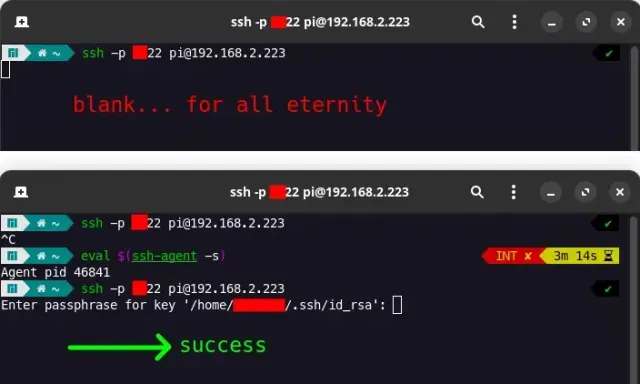
I have my own ssh server (on raspberry pi 5, Ubuntu Server 23) but when I try to connect from my PC using key authentication (having password disabled), I get a blank screen. A blinking cursor.
However, once I enter the command eval "$(ssh-agent -s)" and try ssh again, I successfully login after entering my passphrase. I don't want to issue this command every time. Is that possible?
This does not occur when I have password enabled on the ssh server. Also, ideally, I want to enter my passphrase EVERYTIME I connect to my server, so ideally I don't want it to be stored in cache or something. I want the passphrase to be a lil' password so that other people can't accidentally connect to my server when they use my PC.
The whole point of ssh-agent is to remember your passphrase. If you don't want to do that your problem might be that for some reason ssh client doesn't pick up your key. Try defining it for the host
Also, there's -v flag for ssh. Use it to debug what's going on when it doesn't try to use your key
I'm always running ssh with the -i parameter and it's a hassle to always type in the correct key for whatever host I'm connecting to.
Is there a config file or something (on Mac) to define which p...
okay I tried that, using -i to specify private key. I get the same thing: blank / blinking cursor. When I use verbose -v flag, I see that in all cases (using -i, the config file, and originally) it ends with these two lines (after about 50 lines) :
debug1: Offering public key: /home/username/.ssh/id_rsa RSA SHA256:j3MUkYzhTrjC6PHkIbre3O(etc) agent
debug1: Server accepts key: /home/username/.ssh/id_rsa RSA SHA256:j3MUkYzhTrjC6PHkIbre3OT(etc) agent
where (etc) is some redacted text. It seems the server is ACCEPTING the key, which is nice. But then it's still a blinking cursor...
I'm not sure which logs I can and should check, but when I listen to this: sudo tail -f /var/log/auth.log
I only get this right after I ctrl+C on my blank / blinking cursor screen. (Did this 3 times in a row.)
2024-08-14T11:35:32.874228+02:00 pidoos sshd[3957]: Connection closed by authenticating user pi MY_PUBLIC_IP port 52242 [preauth]
2024-08-14T11:35:50.168160+02:00 pidoos sshd[3975]: Connection closed by authenticating user pi MY_PUBLIC_IP port 39266 [preauth]
2024-08-14T11:35:55.236347+02:00 pidoos sshd[3987]: Connection closed by authenticating user pi MY_PUBLIC_IP port 41318 [preauth]
Where MY_PUBLIC_IP is redacted. I'm not even sure why my public IP is showing. I connect locally. But ports are forwarded, yes.
Using sudo journalctl -u sshd -f does not seem to output anything...
Not OP but everytime I used the verbose output of ssh it didn't help me one bit. Even adding outrageous verbosity I was still quite confused on what step failed and which didn't.
I'm probably just bad at understanding SSH but i don't know it seems like ssh workflow includes many trial and error until it finds a way to connect.
Imo the verbose output of SSH is often not very helpful if you don't know very well ssh in the first place. Obviously it is still worth a shot and a good advice but don't expect ssh to clearly state what is going on :)
Well, you have configuration and flag options to define what is it supposed to be trying to use. What order, I think too. But definitely understanding SSH a little bit will make the log more understandable. As with everything tbh :D
Are you serious about network security? Then check out SSH, the Secure Shell, which provides key-based authentication and transparent encryption for your network connections.
The whole point of ssh-agent is to remember your passphrase.
replace passphrase with private key and you're very correct.
passphrases used to login to servers using PasswordAuthentication are not stored in the agent. i might be wrong with technical details on how the private key is actually stored in RAM by the agent, but in the context of ssh passphrases that could be directly used for login to servers, saying the agent stores passphrases is at least a bit misleading.
what you want is: - use Key authentication, not passwords - disable passwordauthentication on the server when you have setup and secured (some sort of backup) ssh access with keys instead of passwords. - if you always want to provide a short password for login, then don't use an agent, i.e. unset that environment variable and check ssh_config - give your private key a password that fits your needs (average time it shoulf take attackers to guess that password vs your time you need overall to exchange the pubkey on all your servers) - change the privatekey ever
... show more
The whole point of ssh-agent is to remember your passphrase.
replace passphrase with private key and you're very correct.
passphrases used to login to servers using PasswordAuthentication are not stored in the agent. i might be wrong with technical details on how the private key is actually stored in RAM by the agent, but in the context of ssh passphrases that could be directly used for login to servers, saying the agent stores passphrases is at least a bit misleading.
what you want is: - use Key authentication, not passwords - disable passwordauthentication on the server when you have setup and secured (some sort of backup) ssh access with keys instead of passwords. - if you always want to provide a short password for login, then don't use an agent, i.e. unset that environment variable and check ssh_config - give your private key a password that fits your needs (average time it shoulf take attackers to guess that password vs your time you need overall to exchange the pubkey on all your servers) - change the privatekey every time immediately after someone might have had access to the password protected privkey file - do not give others access to your account on your pc to not have to change your private key too often.
also an idea: - use a token that stores the private key AND is PIN protected as in it would lock itself upon a few tries with a wrong pin. this way the "password" needed to enter for logins can be minimal while at the same time protecting the private key from beeing copied. but even then one should not let others have access to the same machine (of course not as root) or account (as user, but better not at all) as an unlocked token could also possibly be used to place a second attacker provided key on the server you wanted to protect.
all depends on the level of security you want to achieve. additional TOTP could improve security too (but beware that some authenticator providers might have "sharing" features which could compromise the TOTP token even before its first use.
FWIW, I've found that the -v flag often doesn't say why it's not using your key, just that it isn't using your key and it has fallen back to password authentication.
It's usually not terribly helpful for figuring out why it's not using your key, just that it's not using your key, which you kind of already know if it's prompting you for a password. lol
Today I Learned: collection of notes, tips and tricks and stuff I learn from day to day working with computers and technology as an open source contributor and product manager
can you expand on that? What do you mean different names? My PC has of course a different username than the server I'm connecting to. The label name at the end of the key is just a comment, so this is also not what you're referring to, I think.
okay I tried that, using -i to specify private key. I get the same thing: blank / blinking cursor. When I use verbose -v flag, I see that in BOTH cases (I see about 50 lines) it ends with these two lines:
debug1: Offering public key: /home/username/.ssh/id_rsa RSA SHA256:j3MUkYzhTrjC6PHkIbre3O(etc) agent
debug1: Server accepts key: /home/username/.ssh/id_rsa RSA SHA256:j3MUkYzhTrjC6PHkIbre3OT(etc) agent
where (etc) is some redacted text. It seems the server is ACCEPTING the key, which is nice. But then it’s still a blinking cursor…
I had a similar construct in my bashrc and forgot the quotes. It didn't throw an error but also didn't work. Took quite a while to find the issue. So personally, I would recommend trying to quote correctly whenever possible.
As mentioned, -v (or -vv) helps to analyze the situation.
My theory is that you already have something providing ssh agent service, but that process is somehow stuck, and when ssh tries to connect it, it doesn't respond to the connect, or it accepts the connection but doesn't actually interact with ssh. Quite possibly ssh doesn't have a timeout for interacting with ssh-agent.
Using eval $(ssh-agent -s) starts a new ssh agent and replaces the environment variables in question with the new ones, therefore avoiding the use of the stuck process.
If this is the actual problem here, then before running the eval, echo $SSH_AUTH_SOCK would show the path of the existing ssh agent socket. If this is the case, then you can use lsof $SSH_AUTH_SOCK to see what that process is. Quite possibly it's provided by gnome-keyring-daemon if you're running Gnome. As to why that process would not be working I don't have ideas.
Another way to analyze the problem is strace -o logfile -f
... show more
As mentioned, -v (or -vv) helps to analyze the situation.
My theory is that you already have something providing ssh agent service, but that process is somehow stuck, and when ssh tries to connect it, it doesn't respond to the connect, or it accepts the connection but doesn't actually interact with ssh. Quite possibly ssh doesn't have a timeout for interacting with ssh-agent.
Using eval $(ssh-agent -s) starts a new ssh agent and replaces the environment variables in question with the new ones, therefore avoiding the use of the stuck process.
If this is the actual problem here, then before running the eval, echo $SSH_AUTH_SOCK would show the path of the existing ssh agent socket. If this is the case, then you can use lsof $SSH_AUTH_SOCK to see what that process is. Quite possibly it's provided by gnome-keyring-daemon if you're running Gnome. As to why that process would not be working I don't have ideas.
Another way to analyze the problem is strace -o logfile -f ssh .. and then check out what is at the end of the logfile. If the theory applies, then it would likely be a connect call for the ssh-agent.
I guess it's worth checking if those names point to the expected binaries, but I also think it would be highly unlikely they would be anything else than just /usr/bin/ssh and /usr/bin/ssh-agent.
meaning it's trying to interact with the ssh-agent, but it (finally) doesn't give a response.
Use the lsof command to figure out which program is providing the agent service and try to resolve issue that way. If it's not the OpenSSH ssh-agent, then maybe you can disable its ssh-agent functionality and use real ssh-agent in its place..
My wild guess is that the program might be trying to interactively verify the use of the key from you, but it is not succeeding in doing that for some reason.
Do you have that file? If not, then unset SSH_AUTH_SOCK will work just as well.
If it does exist, then I suppose it has good chances of working correctly :). ssh-add -l will try to use that socket and list your keys in the service (or list nothing if there are no keys, but it would still work without error).
My theory is that you already have something providing ssh agent service
in the past some xserver environments started an ssh-agent for you just in case of, and for some reason i don't remember that was annoying and i disabled it to start my agent in my shell environment as i wanted it.
also a possibility is tharlt there are other agents like the gpg-agent that afaik also handles ssh keys.
but i would also look into $HOME/.ssh/config if there was something configured that matches the hostname, ip, or with wildcards* parts of it, that could interfere with key selection as the .ssh/id_rsa key should IMHO always be tried if key auth is possible and no (matching) key is known to the ssh process, that is unless there already is something configured...
not sure if a system-wide /etc/ssh/ssh_config would interfere there too, maybe have a look there too. as this behaviour seems a bit unexpected if not configured specially to do so.
This kind of stuff often happens because there's a ton of terrible advice online about managing ssh-agent - make sure there's none if that baked into your shellrc.
Okay, that agent process is running but it looks wedged: multiple connections to the socket seem to be opened, probably your other attempts to use ssh.
The ssh-add output looks like it's responding a bit, however.
I'd use your package manager to work out what owns it and go looking for open bugs in the tool.
(Getting a trace of that process itself would be handy, while you're trying again. There may be a clue in its behaviour.)
The server reaponse seems like the handshake process is close to completing. It's not immediately clear what's up there I'm afraid.
If not and you're happy with rhe lack of closure, you can potentially fix this: kill the old agent (watch out to see if it respawns; if it does and that works, fine). If it doesn't, you can (a) remove the socket file (b) launch ssh-agent with the righr flag (-a $SSH_AGENT_SOCK iirc) to listen at the same place, then future terminal sessions that inherit the env var will still look in the right place. Unsatisfactory but it'll get you going again.







Art by Harubaki













Credit: Tirrelous
Twitter DM conversation.
Art: CMYKat
Art: CMYKat
Art: CMYKat













Bean
in reply to julian • • •Documentation is absolutely an essential part of it, but I think it might be worth stepping back a bit more and acknowledging that "needs more documentation" is still a techie response to this challenge.
What the Fediverse needs is a good PR person lol. It needs communication, not documentation. Communication is relating ideas to laymen and showing them why Fedi is exciting for them, not just why it's technically cool or how it works.
One of the central concepts to the Fediverse is the abstraction between content and presentation. That's really what it's all about: my instance is responsible for presentation, but the content can be viewed anywhere. And the problem is that people don't get how a Facebook post could be a Tweet. And even if they can get that, it's more confusing how a Reddit post could be an Instagram post.
For this to work and to at least get users onboard in the first place -- and I think NodeBB does a great job of this overall -- Fedi platforms need to be transparent to users. NodeBB needs to just work as a forum for forum us
... show moreDocumentation is absolutely an essential part of it, but I think it might be worth stepping back a bit more and acknowledging that "needs more documentation" is still a techie response to this challenge.
What the Fediverse needs is a good PR person lol. It needs communication, not documentation. Communication is relating ideas to laymen and showing them why Fedi is exciting for them, not just why it's technically cool or how it works.
One of the central concepts to the Fediverse is the abstraction between content and presentation. That's really what it's all about: my instance is responsible for presentation, but the content can be viewed anywhere. And the problem is that people don't get how a Facebook post could be a Tweet. And even if they can get that, it's more confusing how a Reddit post could be an Instagram post.
For this to work and to at least get users onboard in the first place -- and I think NodeBB does a great job of this overall -- Fedi platforms need to be transparent to users. NodeBB needs to just work as a forum for forum users, and any topics posted there need to just work as a post for Mastodon users, just work as a topic for Lemmy users, etc.
Caesar reshared this.
eeeee
in reply to julian • • •Re: Explaining the fediverse is a hard problem.
As an example as the disconnect between the thread on Nodebb and Discourse, @bumblefudge@socialhub.activitypub.rocks 's post is missing from nodebb sites thread.

And conversley some of Ceasars posts are in this thread but not that one.
Isnt the goal to duplicate all posts in all places so they stay in sync?
Caesar
in reply to eeeee • • •Caesar
in reply to Caesar • • •socialhub.activitypub.rocks/t/explaining-the-fediverse-is-a-hard-problem/4462/4 · BrowserPub · A browser for exploring ActivityPub and the fediverse
browser.pub