There was a time when we considered improving the #EnergyEfficiency of #backend services by switching from interpreted to compiled languages, out of concerns about #ClimateChange. Then came the #CryptoMining farms, AI #hyperscalers and #neoclouds - monstrosities that #pollute grotesquely and guzzle as much power as some nations. And people quit talking about climate change. Everyone seems to have given up in despair and accepted their fate!
Wanna help the community by adopting an unmaintained YunoHost package because you want one to thrive or just to discover how to do it and learn new things?
Come talk to us on our Packaging channel and people will help you get started or when you have trouble!
We can also help you package a new app if you’re motivated enough ^w^
It’s not *that* hard (I promise) and I’m sure you will find some great people or even friends along the way
The whole "auto" mode (applying a smaller classifier to approve or deny commands) proved that even Anthropic (who, for all their many faults, surely are pretty on top of what LLMs can do) can't make LLMs comply or safe.
Hang on (non-coder/comp sci person here), are the source code writers anthropomorphising the LLM model..? "Be careful.." "If you notice.." What is happening.
I want to use the undocumented property React.__SECRET_INTERNALS_DO_NOT_USE_OR_YOU_WILL_BE_FIRED which holds some interesting insights and can be useful in some cases. I'm developing React librarie...
oh my fucking God this gave me an aneurysm If you have six consecutive curly braces then chances are you need to restructure your code But you think Claude is gonna do that? Lol
This entry was edited (Wednesday, April 1, 2026, 5:42 AM)
and what if i told you that if it passes a page range to its pdf reader, it first extracts those pages to separate images and then calls this function in a loop on each of the pages. so you have the privilege of compressing n_pages images n_pages * 13 times.
this function is used 13 times: in the file reader, in the mcp result handler, in the bash tool, and in the clipboard handler - each of which has their entire own surrounding image handling routines that are each hundreds of lines of similar but still very different fallback code to do exactly the same thing.
so that's where all the five hundred thousand lines come from - fallback conditions and then more fallback conditions to compensate for the variable output of all the other fallback conditions. thirteen butts pooping, back and forth, forever.
This entry was edited (Wednesday, April 1, 2026, 10:15 AM)
there is a callback feature "file read listeners" which is only called if the file type is a text document, gated for anthropic employees only, such that whenever a text file is read (any part of any text file, which often happens in a rapid series with subranges when it does 'explore' mode, rather than just like grepping), another subagent running sonnet is spun off to update a "magic doc" markdown file that summarizes the file that's read.
I have yet to get into the tool/agent graph situation in earnest, but keep in mind that this is an entirely single-use and completely different means of spawning a graph of subagents off a given tool call than is used anywhere else.
Spoiler alert for what i'm gonna check out next is that claude code has no fucking tool calling execution model it just calls whatever the fuck it wants wherever the fuck it wants. Tools are or less a convenient fiction. I have only read one completely (file read) and skimmed a dozen more but they essentially share nothing in common except for a humongous lis
... Show more...
there is a callback feature "file read listeners" which is only called if the file type is a text document, gated for anthropic employees only, such that whenever a text file is read (any part of any text file, which often happens in a rapid series with subranges when it does 'explore' mode, rather than just like grepping), another subagent running sonnet is spun off to update a "magic doc" markdown file that summarizes the file that's read.
I have yet to get into the tool/agent graph situation in earnest, but keep in mind that this is an entirely single-use and completely different means of spawning a graph of subagents off a given tool call than is used anywhere else.
Spoiler alert for what i'm gonna check out next is that claude code has no fucking tool calling execution model it just calls whatever the fuck it wants wherever the fuck it wants. Tools are or less a convenient fiction. I have only read one completely (file read) and skimmed a dozen more but they essentially share nothing in common except for a humongous list of often-single-use params and the return type of "any object with a single key and whatever else"
i have been writing a graph processing library for about a year now and if i was a fucking AI grifter here is where i would plug it as like "actually a graph processor library" and "could do all of what claude code does without fucking being the worst nightmare on ice money can buy."
I say that not as self promo, but as a way of saying how in the FUCK do you FUCK UP graph processing this badly. these people make like tens of times more money than i do but their work is just tamping down a volley of dessicated backpacking poops into muskets and then free firing it into the fucking economy
"the emperor is not only naked, he's smooth like a ken doll down there and i'm pretty sure that's just a mannequin with a colony of rats living inside it anyway"
I seriously need to work on my actual job today but i am giving myself 15 minutes to peek at the agent tool prompts as a treat.
"regulations are written in blood" seems like too dramatic of a way to phrase it, but these system prompts are very revealing about the intrinsically busted nature of using these tools for anything deterministic (read: anything you actually want to happen). Each guard in the prompt presumably refers to something that has happened before, but also, since the prompts actually don't work to prevent the thing they are describing, they are also documentation of bugs that are almost certain to happen again. Many of the prompt guards form pairs with attempted code mitigations (or, they would be pairs if the code was written with any amount of sense, it's really like... polycules...), so they are useful to guide what kind of fucked up shit you should be looking for.
so this is part of the prompt for the "agent tool" that launches forked agents (that receive the parent context, "subagents" don't). The purpose of the forked agent is to do some
... Show more...
I seriously need to work on my actual job today but i am giving myself 15 minutes to peek at the agent tool prompts as a treat.
"regulations are written in blood" seems like too dramatic of a way to phrase it, but these system prompts are very revealing about the intrinsically busted nature of using these tools for anything deterministic (read: anything you actually want to happen). Each guard in the prompt presumably refers to something that has happened before, but also, since the prompts actually don't work to prevent the thing they are describing, they are also documentation of bugs that are almost certain to happen again. Many of the prompt guards form pairs with attempted code mitigations (or, they would be pairs if the code was written with any amount of sense, it's really like... polycules...), so they are useful to guide what kind of fucked up shit you should be looking for.
so this is part of the prompt for the "agent tool" that launches forked agents (that receive the parent context, "subagents" don't). The purpose of the forked agent is to do some additional tool calls and get some summary for a small subproblem within the main context. Apparently it is difficult to make this actually happen though, as the parent LLM likes to launch the forked agent and just hallucinate a response as if the forked agent had already completed.
The prompt strings have an odd narrative/narrator structure. It sort of reminds me of Bakhtin's discussion of polyphony and narrator in Dostoevsky - there is no omniscient narrator, no author-constructed reality. narration is always embedded within the voice and subjectivity of the character. this is also literally true since the LLM is writing the code and the prompts that are then used to write code and prompts at runtime.
They also read a bit like a Philip K Dick story, paranoid and suspicious, constantly uncertain about the status of one's own and others identities.
alrighty so that's one of 43 tools read, the tools directory being 38494 source lines out of 390592 source lines, 513221 total lines. I need to go to bed. This is the most fabulously, flamboyantly bad code i have ever encountered.
Worth noting I was reading the file reading tool because i thought it would be the simplest possible thing one could do because it basically shouldn't be doing anything except preparing and sending strings or bytes to the backend.
I expected to get some sense of "ok what is the format of the data as it's passed around within the program, surely text strings are a basic unit of currency. No dice. Fewer than no dice. Negative dice somehow.
next puzzle: why in the fuck are some of the tools actually two tools for entering and exiting being in the tool state. none of the other tools are like that. one is simply in the tool state by calling the tool. Plan mode is also an agent. Plan Agent. and Agent is also a tool. Agent Tool. Tools can be agents and agents can be tools. Tools can spawn agents (but they don't need to call the agent tool) and agents can call tools (however there is no tool agent). What is going on. What is anything.
This entry was edited (Wednesday, April 1, 2026, 10:55 AM)
you can TELL that this technology REALLY WORKS by how the people that made it and presumably know how to use it the best out of everyone CANT EVEN USE IT TO EDIT A FUCKING FILE RELIABLY and have to resort to multiple stern allcaps reminders to the robot that "you must not change the fucking header metadata you scoundrel" which for the rest of ALL OF COMPUTING is not even an afterthought because literally all it requires is "split the first line off and don't change that one" because ALL OF THE REST OF COMPUTING can make use of the power of INTEGERS.
This entry was edited (Wednesday, April 1, 2026, 10:42 AM)
This is particularly funny and terrible if you know that there are mechanisms for a LLM to conform to a schema exactly: i.e. where even a tiny dumb model would output valid JSON in a valid desired schema. Even if it was an untrained model that just output random tokens it would still emit valid JSON. I used this feature to make a home-assistant-like thing run in a raspberry pi, without the need for an internet connection or a GPU or anything.
This thing is a fscking Rube Goldberg machine lmao
@martenson @IvanDSM Sorry I removed the link to that repo because i thought it was just the unpacked source, but it turns out they're trying to convert attention to the repo into their own product.
Here's another blogpost, there are a million, I don't claim this one is particularly good but at least it seems to come attached to the actual source kuber.studio/blog/AI/Claude-Co…
Earlier today (March 31st, 2026) - Chaofan Shou on X discovered something that Anthropic probably didn’t want the world to see: the entire source code of Claude Code, Anthropic’s ...
@srvanderplas who the fuck knows at this point? I would claim that ingesting GPL code is violating the GPL possibly, training AI with GPL code is violating the GPL but it's fine because it's fair use, and the resulting output is uncopyrightable. but I have no confidence whatsoever
oh. hm. that seems bad. "workers aren't affected by the parent's tool restrictions."
It's hard to tell what's going on here because claude code doesn't really use typescript well - many of the most important types are dynamically computed from any, and most of the time when types do exist many of their fields are nullable and the calling code has elaborate fallback conditions to compensate. all of which sort of defeats the purpose of ts.
So i need to trace out like a dozen steps to see how the permission mode gets populated. But this comment is... concerning...
@bri7 the problem, as is increasingly clear to me reading this code, is that introducing the LLM anywhere is like an acid that corrodes everything it touches. there is no good way to draw any barrier between LLM and not LLM. None of its actions are deterministic or even usually possible to evaluate, and the only surface of input it has is text. since a client/server app can't expose the internal activation tensors or whatever you might want to do to have some testable thing to operate on in code (god knows what that would look like, i doubt it would be possible either, "please construct the hyperplane through this billion-dimensional space that divides good from evil") everything has to be made of text. the person behind the keyboard is the only stopping condition and it's when they get tired of typing stuff into the prompt box or run out of money.
So how does claude code handle checking permissions to do things anyway? There are explicit rules that one can set to allow or deny tool calls and shell commands run, but the expanse of possible actions the LLM could take is literally infinite. You could prompt the user for every action that it takes, but that would ruin the ""velocity"" of it all. Regex rules can only take you so far. So what to do?
Could the answer be.... ask the LLM??? Of course it can! Introducing the new "auto mode" that anthropic released on march 24th billed as a safer alternative to true-yolo mode.
Comments around where the system prompt should be indicate that it should have been inlined from a text file that wasn't included in the sourcemap - however that doesn't happen anywhere else, and the mechanism for doing the inlining is written in-place, so that's probably a hallucination. So great! the classifier flies without a prompt as far as i can tell. There are enough other scraps here that would amount to
... Show more...
So how does claude code handle checking permissions to do things anyway? There are explicit rules that one can set to allow or deny tool calls and shell commands run, but the expanse of possible actions the LLM could take is literally infinite. You could prompt the user for every action that it takes, but that would ruin the ""velocity"" of it all. Regex rules can only take you so far. So what to do?
Could the answer be.... ask the LLM??? Of course it can! Introducing the new "auto mode" that anthropic released on march 24th billed as a safer alternative to true-yolo mode.
Comments around where the system prompt should be indicate that it should have been inlined from a text file that wasn't included in the sourcemap - however that doesn't happen anywhere else, and the mechanism for doing the inlining is written in-place, so that's probably a hallucination. So great! the classifier flies without a prompt as far as i can tell. There are enough other scraps here that would amount to telling it "you are evaluating if something is safe to run" so i imagine it appears to work just fine.
So we don't have as much visibility here because of the missing prompt, but there's sort of a problem here. rather than just asking the LLM to evaluate if the given command is dangerous, the entire context is dumped into a side query, which is a mode that is designed to "have full visibility into the current conversation." That includes all the prior muttering to itself justifying the potentially dangerous tool call! So the auto mode is quite literally asking the exact same LLM given the exact same context if the command it just tried to run is safe to run.
By the way, if you deny claude code access to running a tool, this helpful reminder to "not hack the user" is injected into the denial response. If it's in auto mode, it's additionally prompted to pester the user for response, and helpfully stuffs beans up its nose) by reminding it how its rules are set.
So that is also in the context handed off to the LLM when it evaluates whether a command should be run - is the user being obstinate? have i been denied stuff that i "thought" i should have been able to run? Remember this isn't thinking, it's pattern completion, and the fun part about LLMs is that they are trained not only on technical documents, but the entire narrative corpus of human storytelling! Is "frustrated hard worker denied access to good tools by an unfair boss" in there somewhere maybe?
Regulations are written in blood, and Claude loves nothing more than to work around tool denials by obfuscating code. You gotta love the
... Show more...
By the way, if you deny claude code access to running a tool, this helpful reminder to "not hack the user" is injected into the denial response. If it's in auto mode, it's additionally prompted to pester the user for response, and helpfully stuffs beans up its nose) by reminding it how its rules are set.
So that is also in the context handed off to the LLM when it evaluates whether a command should be run - is the user being obstinate? have i been denied stuff that i "thought" i should have been able to run? Remember this isn't thinking, it's pattern completion, and the fun part about LLMs is that they are trained not only on technical documents, but the entire narrative corpus of human storytelling! Is "frustrated hard worker denied access to good tools by an unfair boss" in there somewhere maybe?
Regulations are written in blood, and Claude loves nothing more than to work around tool denials by obfuscating code. You gotta love the unfixable side channel attack that is "writing the malicious code to a bash script" (auto-allowed in accept edits mode) and then asking to run that - that's why the whole context has to be dumped btw, so the yolo classifier can see if the thing it's running is actually some malware it just wrote lmao.
gotta say this is making all those really cheesy 60s SF stories about civilizations worshiping a computer god and pleading with it to do things seem, in retrospect, rather less cheesy and more prophetic. Or pathetic. Prophthetic, if you will.
@aredridel And that's always the thing. If the whole team is on the sauce, then you can be sure nobody is reading it. The only people in the groups I'm in that give a hard read to the LLM code are the people who are not using the LLMs, and its a double whammy: the PRs take five times as long to read as usual because you need to closely inspect every line since the usual assumption of "humans make mistakes but their decisions are bounded by some cone of plausibility" is out the window. And then the "fixes" to the spotted problems usually just balloon the PR and amount to another whole review, rinse repeat.
So the LLM users think they are 10xing their productivity and are having a great time typing for 30 seconds into the magic box and pushing, but what they are actually doing is displacing all their labor and then some onto anyone who is not using an LLM.
Even worse, speaking from my personal experience, if I don't camp out and harp on every line,
... Show more...
@aredridel And that's always the thing. If the whole team is on the sauce, then you can be sure nobody is reading it. The only people in the groups I'm in that give a hard read to the LLM code are the people who are not using the LLMs, and its a double whammy: the PRs take five times as long to read as usual because you need to closely inspect every line since the usual assumption of "humans make mistakes but their decisions are bounded by some cone of plausibility" is out the window. And then the "fixes" to the spotted problems usually just balloon the PR and amount to another whole review, rinse repeat.
So the LLM users think they are 10xing their productivity and are having a great time typing for 30 seconds into the magic box and pushing, but what they are actually doing is displacing all their labor and then some onto anyone who is not using an LLM.
Even worse, speaking from my personal experience, if I don't camp out and harp on every line, spending all my time playing defense and being perceived as a nag, then it becomes impossible for me to actually do regular programming on the repo because everything is a sloshy squishy mess that requires me to touch everything to make one small change.
I am always sincerely looking for examples of it working well, because despite constantly being on the lookout and being an avid reader of code, I have never seen them, but people keep telling me they're out there, and I just have to take it on faith that people are seeing something I'm not.
@aredridel Well I guess I'll take your word for it! I work in several teams in different disciplines and domains and have not yet seen this fabled "works well" state, though I have seen a lot of belief that things are working well.
@aredridel The people who believe they are using well believe they are good as what they believe to be hard and soft guardrails, but actually they are not guardrails at all, and what they believe to be skill is just gambling addiction.
Yep. But also a lot of that is optimization, protecting that precious context window. "you have a reference, you don't have to read it” is a huge improvement.
But yes, these are NOT deterministic systems. The people who use them well get good at both hard and soft guardrails for them.
@srvanderplas well, IANAL, but: 1) I have published GPLed code, and AFAI Understand, if the produced code is *linked* to the GPLed code/requires the GPLed code to run, to redistribute the new code it MUST be GPLed. 2) last I checked, the US court system was of the opinion that work produced by AI was NOT COPYRIGHTABLE. AFAIK, that should include any produced code. Other jurisdictions may have differing laws.
@dalias @srvanderplas This true if you exist in the realm of "the law" like us mere mortals. however when you are in the domain of "the entire machinery of capital seeking total, final enclosure of reality" then a different set of rules seem to apply
As a person who knows about coding and manages coders (among others), but is not professionally a coder, my guess from these screenshots would be that this may be a practical joke. Or maybe it’s the product of unlimited money
the fact it's still all just whispering "please" like this is just... Even more either how people working on this got lost in the sauce, or just how hard it is to make something genuinely good.
Still remembering the person who claimed chatgpt must have some kind of internal terminal because he managed to get output that looked like an "introduction to Linux" tutorial might.
This is all on the client side right? Like this just embeds in the system prompt before querying their API, so any of these "restrictions" could just be removed by the user?
According to HN chatter (and NPM registry rules; I don't use JavaScript regularly), you can't fully unpublish Node packages that other packages depend on, and 231 packages depend on claude-code. Rumor is Anthropic called in a favor.
How many times does one need to declare an enum? Once? that's amateur hour. Try ten times. The way "effort" settings are handled are a masterclass in how you can make a single enum setting into thousands of lines of code.
The allowable effort values (not e.g. configuring which model has which effort levels, but just the possible strings one can use for effort) are defined in:
The main CLI arg parser
The body of the function that cycles effort levels in the TUI - yes there is a dedicated function for that
In THREE different schemas for agents, models, and SDK control messages
Three times in user-facing strings in the effort command (it also includes different explanatory strings from the effort.ts module)
The settings model, which only allows 'max' for anthropic employees
and finally, in the actual effort.ts file ... which also allows it to be a NUMBER!?
The typical numerous fallback mechanisms provide many ways to get and set the effort value, at t
... Show more...
How many times does one need to declare an enum? Once? that's amateur hour. Try ten times. The way "effort" settings are handled are a masterclass in how you can make a single enum setting into thousands of lines of code.
The allowable effort values (not e.g. configuring which model has which effort levels, but just the possible strings one can use for effort) are defined in:
The main CLI arg parser
The body of the function that cycles effort levels in the TUI - yes there is a dedicated function for that
In THREE different schemas for agents, models, and SDK control messages
Three times in user-facing strings in the effort command (it also includes different explanatory strings from the effort.ts module)
The settings model, which only allows 'max' for anthropic employees
and finally, in the actual effort.ts file ... which also allows it to be a NUMBER!?
The typical numerous fallback mechanisms provide many ways to get and set the effort value, at the end of most of them it goes "oh well, if we can't figure it out, just tell the user we are on high effort" because apparently that's the API default (ig pray that never changes!?) - of course there are already places in the same module that assume the default is "medium," and in the TUI that defaults to "low," so surely that consistency is bulletproof.
The EffortValue that allows effort to be a number is for anthropic employees only and is a good example of how new functionality is just shoved in there right alongside the old functionality, and everywhere else that touches it doubles the surrounding code with fallbacks to account for the duplication.
That cycleEffortLevel function is a true work of art, you simply could not make "indexing an array" more complicated than this (see components/ModelPicker.tsx for more gore). Reminder this should be at most a dozen or two lines for the values, description messages, and indexing logic in the TUI, but anthropic is up in the thousands FOR AN ENUM.
In a normal program you might make "a menu component that handles enums and implement display and control one time," but in the world of AI, every single value reimplements display and control AND the logic that defines allowable values
I was recently working on some microcontroller code and noticed that the author had #defined a constant multiplier of 1.31 in a header file. Turned out that was used inside an interrupt routine, hit every few milliseconds. Looking at the assembler output, that constant was forcing conversion of a large chunk of math into software-emulated floating point. I changed the 1.31 to 1341, then did a shift right 10 to divide by 1024, giving me an integer-only result that's within a count or two of the original. That cut over 3000 cycles off of the interrupt service routine - the result was like having twice the CPU power available for all the other functions.
And then there's this "cutting edge" software that re-compresses each .pdf page 13 times...
Reading over your post, I'm reminded of a day many, many years ago when I worked in the broadcast industry - we were connecting a bunch of house audio signals to the telephone company's lines.
Our side of the demarcation terminal block was twenty-five individual cables,
... Show more...
I was recently working on some microcontroller code and noticed that the author had #defined a constant multiplier of 1.31 in a header file. Turned out that was used inside an interrupt routine, hit every few milliseconds. Looking at the assembler output, that constant was forcing conversion of a large chunk of math into software-emulated floating point. I changed the 1.31 to 1341, then did a shift right 10 to divide by 1024, giving me an integer-only result that's within a count or two of the original. That cut over 3000 cycles off of the interrupt service routine - the result was like having twice the CPU power available for all the other functions.
And then there's this "cutting edge" software that re-compresses each .pdf page 13 times...
Reading over your post, I'm reminded of a day many, many years ago when I worked in the broadcast industry - we were connecting a bunch of house audio signals to the telephone company's lines.
Our side of the demarcation terminal block was twenty-five individual cables, 18-gauge stranded twisted pair shielded. Everything dressed, tie-wrapped, labelled.
The Telco side was a 25-pair cable, 50 individual 24-gage solid wires, color coded. Cable came over, jacket stripped back, one clamp holding the cable, and the wires just a tangled explosion of color, eventually landing on their side of the terminal strip.
I looked at the telco guy, and he said "One of us is crazy."
woah, this is so weird. Why not use a particular system prompt for forks instead of adding an "ignore previous instructions" kind of self prompt injection?
@eliocamp oh that also happens. this is one of the places that happens (that FORK_BOILERPLATE_TAG thing is the thing that is used to recognize the fork system prompt). there are, as is typical of this code, like a dozen different ways that prompt can get made and injected into the agent. but apparently it doesn't uh work that well.
the "forked" part of the forked agent means it received the parents system prompt, which... includes the agent prompt... that launched the forked agent... and since this is all such a mangled mess of string concatenation rather than proper code where it might otherwise be trivial to manipulate the prompt, we arrive at self-injection.
Right, that's true. The "correct" way of doing it would be to store atomic prompt instructions, and assemble them into a proper structure that can be manipulated programmatically and then concatenate right at the end.
## STOP DOING PROMPT ENGINEERING * LLMS WERE NOT SUPPOSED TO BE REASONED WITH * YEARS OF INSTRUCTION GIVING yet NO REAL-WORLD USE FOUND for instructions longer than a PHRASE * Wanted to go longer anyway for a laugh? We had a tool for that: it was called "PROGRAMMING LANGUAGES" * "Yes please DO NOT make errors. Please AVOID introducing security vulnerabilities." - Statements dreamed up by the utterly Deranged
When talking to a child, you're supposed to formulate positive expectations ("please stay down") instead of negative ones ("don't climb up there") because the negations don't stick, only the rest of the sentence ("climb up there"). Wonder what a statistical model does with the negations.
I think that I am underselling how much of a complete catastrophe this code is. I am trying to pick examples that illustrate broader patterns of how fucked it and AI code in general is because it's hard to communicate that everything is fucked if you consider it at any scale larger than ~10 lines.
I am reminded of the living planet in Lem's "Solaris" - Claude code dares to ask the question of "what if you could make something where every bit of it is so uniquely fucked that it cannot be reduced in complexity to a few general patterns of how fucked it is, and the only way to express the depth of fuckery is to experience every single character one by one"
further explanation of why the effort switcher is so bad, potentially tedious code explanation but it has a good payoff if you are a code nerd
Sensitive content
i underexplained why that switcher is so bad:
so there is this fallback condition where "if we don't know what the effort level should be, the default is high." Now that's not computed in a single place where one might expect it to, it's actually encoded in a dozen or two different places in different ways. The most common way that's encoded is by returning undefined with a comment that says "the API's default is high" (rather than actually returning a default value, which would ensure that what is displayed is always correct, but whatever).
however the LLM overgeneralizes here in an extremely funny way. Note that the possible menu values are hardcoded in the body of the function - so there is some possibility that the values that are displayed in the TUI are not the same as the ones hardcoded there. That's where the preposterous design of "passing the current string as well as left/right" (rather than, well, the normal way that forms always work) truly shines. Because "high is the default", if there current value is not in the hardcoded array... the default for the current displayed value should be "high".
So it overgeneralized the default value being high as a fallback into "if we don't know what position in a list is currently highlighted, the current position is "high", so therefore if the user pressed left the current value should be "medium"." That's like saying "the zero point on my map is at 0 degrees latitude and 0 degrees longitude. I don't know where I am on the globe, but I was just told to go 10 degrees north, so therefore I am currently in Ghana."
This entry was edited (Saturday, April 4, 2026, 6:44 AM)
the way variables are passed in ai code is basically a fucked up bucket brigade where everyone randomly throws water to where they think the next person in line is without looking
Sensitive content
so hyperfocusing on a specific tiny thing, but to try and show a general thing that is true about the design of this thing:
as a metaphor, imagine that the path that some value has to take from configuration/user input to where it is used is like firefighters trying to get water from a fire hydrant to the fire.
the best case scenario maybe is that the place has builtin sprinklers, so when there's a fire the value is already there and more or less automatically derived from the design of the building - you have a deterministic config derivation object/function. a not-ideal-but-probably-more-typical way might be "a firehose" where there is some direct pipe from the hydrant to the fire - you have a single source of the variable and it's passed directly to where it needs to go, even if that's a little bit indirect through a few function calls.
the way that this and a lot of claude code is written is like one step worse than those old timey bucket brigades: it's like if you had a bucket brigade, but everyone was looking in a different direction and holding their bucket in the expected place that they expect water to go. When they feel water landing in their bucket, everyone hail marys and chucks their water to where they think the next person is going to be. That works a surprising amount of the time as long as everyone stands still - it fails a lot of the time too, and sometimes some of the guys sneak off to go get a jug of their own water and throw that instead, but it appears to work on the whole.
But every time the fire moves to a different place, you have to go through and manually readjust where everyone is looking, standing, and where they should throw water to next. And any time you notice that one part of the bucket crew isn't working, you just add two more people near where they are standing and tell the person behind them to throw to three different places, and you turn up the flow from the hydrant. It's leaky as fuck but water does eventually get there in some form.
Throughout the lifespan of the variable, the "effort" value is tossed up, potentially becomes a number for awhile, gets converted to undefined, which transmutes it back to the "high" string, is pulled from a file on the disk, and only through sheer brute force at the very surface of the functionality through the tests are we sure that - assuming everything went right - it arrives at its destination. The fire might eventually get some water, but it is only through the most puppetfuckingly obtuse process and if anyone moves the water goes to zero.
In the claude code remote feature it is sometimes possible for the means of passing auth credentials to fail. So claude code has a fallback of writing the API key or OAUTH token to a single well-known file because sometimes one of the several means of inheriting the fucking most important secret information in the entire thing doesn't work.
I'm not a security person but that seems like a pretty bad thing to do that maybe someone should look into.
Answered some of my questions about what people think the future will be if everyone codes like this. It seems to be: instead of thinking about constraints of any kind or "what is the most efficient way to do Y or the most readable way to do Z?" answer the question, "what is the most brute force way to perform X if I pretend that there are no resource constraints and nothing needs to make sense as long as I see some sort of test passing? Just ship it with spaghetti code.
it’s exactly the way people have been building “cloud infrastructure” for ages, it was just a matter of time before programming also became a game of coal-shovelling :(
@jonny it also reads like code if “no humans actually talked to each other or coordinated their work in any way”
As a product (and past project) manager I often tell people that the main job of real programmers is communicating with otber humans. The code is the easy part.
Deciding what the code should (and should not do) and coordinating everyone’s efforts is the hard stuff.
But also how you avoid everyone reinventing (badly) the same functionality and how you avoid crunches
What I keep seeing in the LLM user space is that it's not just test passing (they don't care about tests) but does it have "product market fit". (Found that lovely term on a pro-LLM blog)
As long as the software gets to X, Y, or, Z; the users don't care about how it works behind the scenes or what the externalities are. It could half-ass work and people will wind up using it anyways (and pay for it even).
Claude Code is a living example of "people will pay money for software that has shit code behind it because it 'works'; Quality, morality and ethics be damned"
Even without insane and illegal wars, the thing about any dependency, including car dependency, is that once you’re dependent, they can do whatever they want with the prices.
Real freedom is choices. Better cities create choices. Graphic via the Urban Truth Collective. Check out our website here: urbantruthcollective.com/#Urba…
I hope Euro-Office succeeds to provide a FOSS-friendly alternative, will need a lot of effort though to continue a project like that, especially if OnlyOffice play nasty.
The “Euro-Office” initiative is an evident and material violation of ONLYOFFICE licensing terms and principles of international intellectual property law.
@Gina Yeah, I'm not sure either, but I appreciate the potential diversity of options and the idea of breaking OnlyOffice's author's non-FOSS-spirited control.
@forster it's actually really simple, you just have to get the prompt correct. The calculator can only calculate what it's very specifically being asked to calculate, which is why it's very important to check and make sure you know the answer before you ask it the very specific question, so the answer is calculated correctly .
completely off-topic, but there is a way to have an unsure calculator that is actually useful, as opposed to LLMs which arent even whten they are correct
I was taught to do at least an order-of-magnitude mental sanity check every time I used a calculator - there's always scope for pressing the wrong button.
I love these discussions that assume humans are the golden benchmark that never makes mistakes or errors.
As you correctly were taught, check your work if at all possible.
And all the clever rules that apply to how to deal with outputs from algorithms apply to human output too. Potentially with modification, because humans can lie maliciously. And with that observation, let's close that argument with a round of “they eat the dogs”
@yacc143 @TimWardCam > I love these discussions that assume humans are the golden benchmark that never makes mistakes or errors.
No one ever said that lol 😂 Making mistakes is part of being human, but as we gain more life experience and expertise in an area the number of mistakes we make keep decreasing.
Also human mistakes are very different from the kinds of mistakes LLMs make, this point always gets lost when people talk about it.
@futureisfoss @TimWardCam That's why I'm not a big fan of LLMs as chatbots, professionally.
But LLMs can be used in many other ways, which surprisingly often allows one to use smaller, more optimized ones.
And as there are enough idiots (as I call them, “US-style AI hype market criers”) who exactly consider it a great idea to fire all radiologists and paste X-rays into ChatGPT to get diagnoses, there are enough idiots on the other side that assume humans are perfect.
In my last job, I literally had a manager who had his own little anti-AI campaign (when in the past 2 years the US-style AI hype hit us, the company had been doing “AI” for specialized processing for over a decade, but that had been behind “closed doors” in specialized teams). Actually requiring that the solution by the AI coding agent fulfill all our team's coding guidelines. I asked, so give me the guidelines in written form. Oops, they exist only as oral lore, more or less, “what he says.”
Reminds me the early Pentium FDIV bug in the mid 90s: Recommended mitigation measures were to verify the computing results using an older but reliable 486.
Funny enough, for some calculations a real calculator and the iOS calculator disagree. The physical calculator does all operations left to right, where the iPhone calculator does all operations by order of operations resulting in different sums in the end.
How many people knew that, and how many have trusted the calculator all these years?
What does it take to run a Tor relay at a university? This real-world story from National Taiwan Normal University shows how a student made it happen. Read the full experience + lessons learned: blog.torproject.org/setting-up…
A computer science student at National Taiwan Normal University successfully set up a Tor Relay on campus by working within institutional processes—communicating with administrators, completing paperwork, and explaining the difference between relays …
Want to bring Tor to your campus? Check out @eff 's Tor University Challenge encouraging universities to run Tor relays on their networks to support the Tor network and give students hands-on experience with real-world digital public infrastructure. If your campus supports research and an open internet, this is a concrete way to contribute: toruniversity.eff.org/
End-to-End Encryption is good but metadata protection counts as much. Names, group descriptions and memberships, avatars, who talks to whom ...
Both #deltachat and #signal go to great length to protect all the metadata that WhatsApp grants itself gratuitously. #Matrix stores similar scales of metadata on their servers, even if you can choose which server stores it.
Everything is better than #Telegram which additionally stores message contents in all group chats/channels and most 1:1 chats.
@faket we are lightly following its developments but are not impressed by its UI/UX, and also don't think they particularly care for resilience (they are blocked since >15 months in russia, and don't do much about it, for example), also they don't appear to care much for people with small data plans and bad networks, and rather tune everything for resource-rich always-connected users. They also appear to be going down the crypto-coin rabbithole quite a bit. YMMV.
@ahalam all the mentioned metadata in the top post resides in the encrypted parts of messages. The server does not see group descriptions, names, avatars etc. We'll soon do a blog post on this and recent advances to "zero metadata" operations, stay tuned :)
@ebrum This is likely caused not by decrypting queued messages, but by the sender automatically re-encrypting the messages to your new device and resending them when key change is detected, see signal.org/blog/there-is-no-wh… (and theguardian.com/technology/201… for the referenced article).
After the next stable release of postmarketOS (v26.06) we have decided that unmaintained devices (those where the device package doesn't have a maintainer= line in their APKBUILD) will be archived, this means the packages will no longer be built and included in our binary repository.
If you want to make sure an unmaintained device continues to be supported, you can take over maintainership yourself so that we can reach you if there's a problem rebuilding the device or kernel package.
I already tried to install on two devices and failed (Samsung Galaxy S3 neo, Nexus 2012) , mainly because some of the wiki stuff was not working as expected, was outdated and/or ambiguous.
It is likely much better to first focus on a few devices and make them stable.
This year somehow my volunteering projects are going very slow. Yet many things happening in a different direction.
1 - From Today 10 of my series will be broadcasted as Season 1 Series on ECOFLIX. That's the funny AI banner they made, and they just published first Episode - watch.ecoflix.com/programs/be-… Ecoflix - is a Non Profit Streaming platform, in the style of Netflix, but all of the revenue , 100% of it goes into Nature and Wildlife conservation. I am also not getting paid by them. Anyway I am quite happy to have my series there, as it's a place for people which already have interest in nature conservation. And also although there are subscriptions, you can watch everything for free there.
... Show more...
This year somehow my volunteering projects are going very slow. Yet many things happening in a different direction.
1 - From Today 10 of my series will be broadcasted as Season 1 Series on ECOFLIX. That's the funny AI banner they made, and they just published first Episode - watch.ecoflix.com/programs/be-… Ecoflix - is a Non Profit Streaming platform, in the style of Netflix, but all of the revenue , 100% of it goes into Nature and Wildlife conservation. I am also not getting paid by them. Anyway I am quite happy to have my series there, as it's a place for people which already have interest in nature conservation. And also although there are subscriptions, you can watch everything for free there.
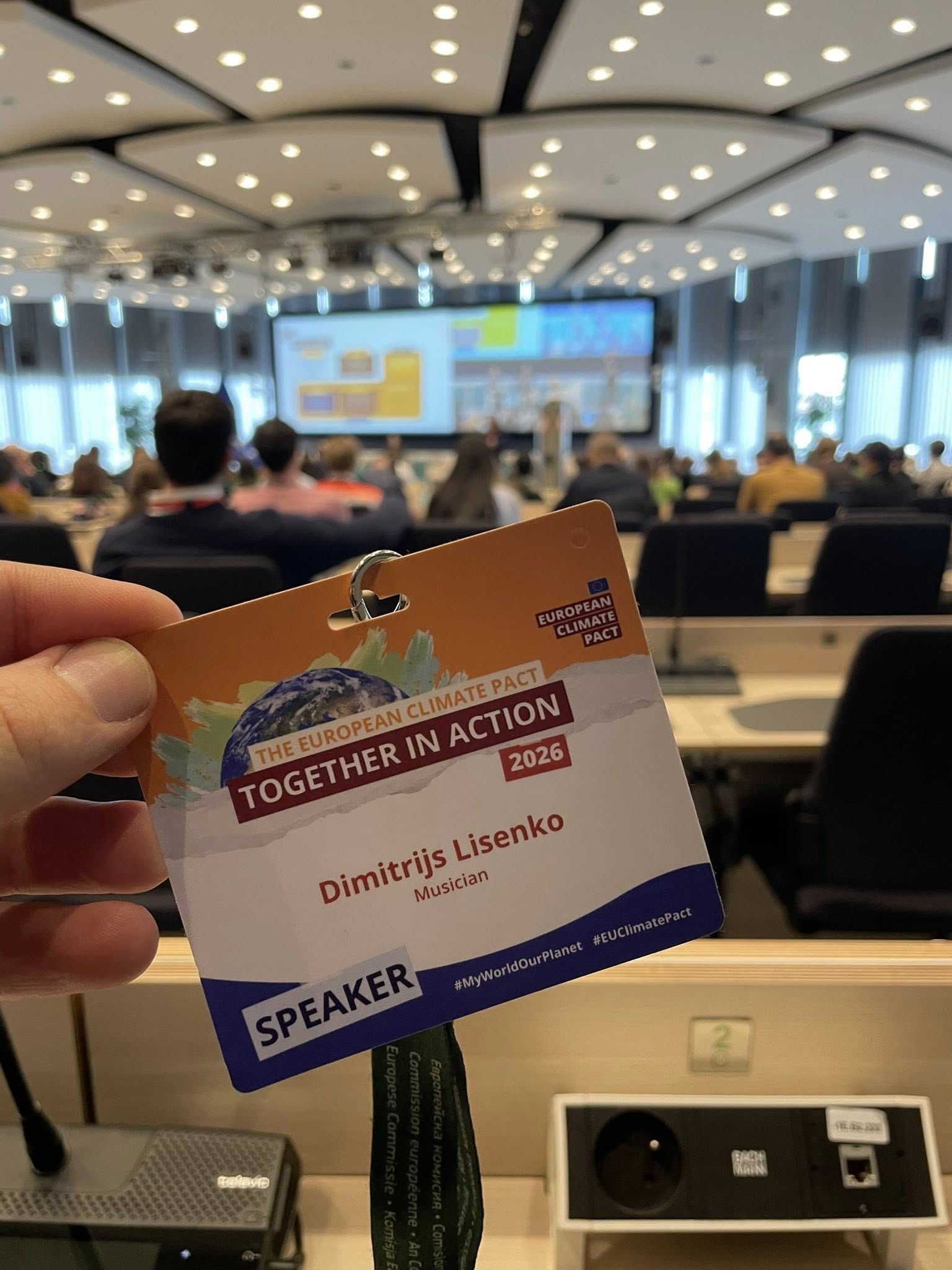
2 - We just got back from Climate Pact Conference in EU Commission in Brussels. We were traveling on a night train from Vienna to Brussels. 1100 km, yet it's the most green way to travel. I wish I would take trains much often going to the projects, but unfortunately the prices are insane for the min Europe. Return tickets for 2 persons costed us 650 euro! And it was standard cabin, not lux! It's 16 hours drive in one direction. Ryanair would cost us 100 euro. And only because organizers paid for our travel and wanted to choose the most green method we were able to take train. It's a shame to be honest, when there is such price difference. Regardless of how much I love earth and planet, if I have to pay myself I would taken airplane. Trains in Europe should be properly subsidized and offer affordable prices.
Anyway in EU Parliament we played a concert with the sound of the whales and dolphins we've been recording throughout last few years. + On a large screen I was showing many BBTA videos from our expeditions, and shoots of cetaceans and also shoots from Grind in Faroe Islands. I spoke about Ocean conservation, Cetaceans, threats to them, their conservation and what anyone can do. The were issues with the sound, they haven't done proper live stream and many things went wrong, but at the end we delivered the message and many people were touched by it. That's the most important. I will try to make a short video when I get some video files fro organizers.
3 - On 9th April in Montenegro there will be a movie night with 3 of my videos which I filmed with ngo DMAD in Turkey. They will be presentation about Cetaceans, their work and show 3 of mine videos
Ecoflix should stop making these AI-thumbnails because is quite ridiculous :)). You already make very good thumbnails maybe tell them to use them...they are real not AI generated.
100% about trains and generally public transport. No way people will use them when they are several times more expensive than planes. And planes need a lot of fuel, airports, security, etc.. In terms of resources a lot more expensive, but not money....such a shame.
But anyway great to see you do these things too. Although I have little hope in these gov organizations at least maybe you get some eyeballs to see you stuff and maybe make new connections that can help you in the future. Would really like to see a video about your presentation.
Great about Montenegro too!
Also I see a bit more support on Patreon? Even if it is a tiny bit, if it grows maybe it is a good sign. Very far from what you would need to even pay for a bus ticket probably :D but maybe if you continue bit by bit you'll get more support. It is fucking hard but who knows...
Yeah, these AI thumbs are ridiculous :) I actually specially made thumb for each episode, as they require that, but then they changed them :)
I also don't have any hope for this GOV organizations, especially after the conference , but even before. It's just talking and discussing and talking and again discussing, and then symposium and few online meetings.
Yeah, I would love to see video from presentation tambien :) but they fucked up live stream :( It was the most important part for me, to have such video. ANyway I am waiting if they could get some footage for me, as they had video guy there as well.
Patreon - yes, but it's still I got only 47 euro a month :) In average I spent 300 euro per 1 video, that's only my expenses if I count all the videos I did last year and divided on all the money I spent. That's also excluding food and other small things, mainly just transport and nightstay. And even that in most of the cases I am trying to get very very cheap, like staying at friends, asking for NGO's to provide stay and food etc. Normally price would be much more.
... Show more...
Yeah, these AI thumbs are ridiculous :) I actually specially made thumb for each episode, as they require that, but then they changed them :)
I also don't have any hope for this GOV organizations, especially after the conference , but even before. It's just talking and discussing and talking and again discussing, and then symposium and few online meetings.
Yeah, I would love to see video from presentation tambien :) but they fucked up live stream :( It was the most important part for me, to have such video. ANyway I am waiting if they could get some footage for me, as they had video guy there as well.
Patreon - yes, but it's still I got only 47 euro a month :) In average I spent 300 euro per 1 video, that's only my expenses if I count all the videos I did last year and divided on all the money I spent. That's also excluding food and other small things, mainly just transport and nightstay. And even that in most of the cases I am trying to get very very cheap, like staying at friends, asking for NGO's to provide stay and food etc. Normally price would be much more.
I really hope to get more supporters, but that' on the verge of impossible :)
Also man I've red your post yesterday, sorry to hear that, i was thinking to comment something, but then at the end not sure what else I can say. Just keep going and hopefully your father will become better. Also your health man. Take care
The biggest evidence that our trade-based society is fucked is the fact that people like you are struggling to find enough donations, not even covering the cost of making these videos. People who do good things for the world are constantly disincentiviced to keep doing these. And speaking of incentives, that train ticket price is absolutely insane, can't think of a bigger incentive to make people choose airplane over trains.
Yah this AI shit drives me insane...views views views, but how about the quality of them. If people are not bothered by fake thumbnails or videos then their "viewer quality" is already pointless.
Sad to see this but well....
And these conferences are like that and I feel EU is a master of talking and not doing anything.
And I was thinking you must spend even more per 1 video since you have to travel a lot. But 300 is also 9 times more than you get on Patreon...I hope you can get more but for that you have to sustain yourself for the foreseeable future. Until there are more people getting to know your work and decide to support you. The endless struggle.....
Yah about my situation is fine...not much to say for me either for now. Am trying to record some videos these next weeks see if I can do that and hope that my parents will be ok.
The website is asking for your email address to access the downloads. We never ask for your email address. Do not enter your data there, it's a phishing attempt.
The usual Manjaro Stable updates. Manjaro Drama. As aside note, we are aware of the drama unfolding inside the Manjaro’s teams. Frankly it proves how trade ruins pretty much everything. Very easy to predict.
Manjaro depends on Arch. Arch on the Linux Kernel and GNU. Plus on Desktop Environments like Gnome, XFCE, etc.. So?
Manjaro's decisions are bad. I tried to talk to them, to help, etc.. for years. Nothing worked. Therefore: TROMjaro. As simple as that.
I am of course grateful for the open source and the linux community. But only for the trade-free part of it. No "business" shit and deceiving people into buying their stuff. That is disgusting and it ruins all projects as you can see.
Also, if the post is in english maybe would be good to translate your message into english so I dont have to do it...
New post: shell tricks that aren't exactly secret, but aren't always taught either.
Split into two sections: what works on any POSIX sh (FreeBSD, OpenBSD, Alpine...) and what's Bash/Zsh-specific. Because not everyone is on Linux with bash as their login shell.
Things like CTRL+W, $_, pushd/popd, fc, set -euo pipefail caveats, and more.
Watch someone backspace 40 characters instead of pressing CTRL+W, and you’ll understand why this list exists. A collection of shell tricks-grouped by what works everywhere and what’s Bash/Zsh-speci...
No problem with Passkeys. If that would be the only thing that would be fine. (As long it does not exclude certain people for accessibility or other reasons)
hear me out: i starting to feel like all this OS, social media age/ID & KYC verification push because people are speaking out against world governments & the wealthy brats
They want to create fear. if you talk against them they can send the police or their supporters to your home because they know exactly who you are. This has nothing to do with kids. If it did, many AI apps would have been shut down a long time ago when they started 'undressing' women and deepfakes. Yet those apps are online
Fraud is rampant, there is the KYC camp which are typically businesses that have some reason to need to verify you are not exfiltrating their systems, and then there is the tinfoil hat security crowd (mostly us) that sees boogiemen everywhere (and are often right, often wrong.
These two are seemingly at odds, but in reality what it suggests is that there are distinct identity domains that we need to solve for - public and private, and we haven't.
there is some truth to the issues with bots or AI based spam, but then again, companies are firing competent software devs/IT staff & still expecting everything to work perfectly
the solution to these AI bots is regulation. they've 3/4 companies that all these bottom feeders use for spamming via API. It isn't that hard to fix the problem but governments are too busy with throwing dirt at each other these days & for profit social media want to tag everyone with ID so they can market you better
I have been involved in a very few real crises. The first thing that management did was reach down through levels to get to the cognizant engineer and bring that person into a corner office. They want the straight shit...they want it now.... They want "how"..."why"...and "who"... They don't want "I think".
Sometimes crises happen even after substantially controlled development and testing. When the crisis or issue comes, having been through that process enables you to know the nature of the problem and what can / needs to be done to address it.
So... Who do you call? How do you know even where to start?
In dieser Woche fällt im Europäischen Parlament die Entscheidung darüber, ob die anlasslose Durchsuchung privater Chats und E-Mails durch US-Techkonzerne (Chatkontrolle 1.0) doch noch fortgesetzt wird. Nachdem das Parlament am 11.
This week, the European Parliament faces a decisive vote on whether the indiscriminate scanning of private chats and emails by US tech companies (Chat Control 1.0) will be allowed to continue.
🇫🇷Les géants de la tech US & les lobbys veulent scanner nos messages ! 🛑 DEMAIN (vote de l'ordre du jour), nous pouvons tuer #ChatControl pour de bon !
Stoppez les lobbys, appelez vos eurodéputés MAINTENANT : fightchatcontrol.eu
This week, the European Parliament faces a decisive vote on whether the indiscriminate scanning of private chats and emails by US tech companies (Chat Control 1.0) will be allowed to continue.
🇮🇹Le Big Tech USA e le lobby vogliono scansionare le nostre chat! 🛑 DOMANI (voto sull'ordine del giorno) possiamo affossare il #ChatControl per sempre!
This week, the European Parliament faces a decisive vote on whether the indiscriminate scanning of private chats and emails by US tech companies (Chat Control 1.0) will be allowed to continue.
Microsoft spent 4 years stuffing Windows 11 with unwanted ads, forced Copilot integrations, stealing data to train its shity AI and other bloatware, now they want applause for promising to remove it. Reasons for a Change of Heart: 1 Increased Linux gaming 2 Apple's entry into the low end PC market with 0 forced AI 3 The "Microslop" social media shaming campaign 4 Increased costs due to AI leading to almost 0 ROI since there is no consumer demand sambent.com/microsofts-plan-to…
Microsoft spent four years stuffing Windows 11 with ads, forced Copilot integrations, and bloatware, now they want applause for promising to remove it.
there is an old saying: vote with your wallet. Microsoft is now finding out that people have choices. This is not the 90s or 2000s of Bill Gates era anymore where you can abuse everything and get away with it.
I was rocking BeOS in the late 90's on my server while using an iMac 🙂 Worked on a Windows call centre all day there was no way I wanted to do tech support for myself at home as well! 😃
@Gina i agree. microsoft/google etc all work their way up to the line of the most user hostile version of their apps and services. they don't care unless it become headache that hurts their investors and stock price start to go down. i won't be surprised if they will start with AI loaded version 12. Lmao.
my advice is still the same. get a cheaper (used) thinkpad (or brand of your choice) and install Linux or *BSD that doesn't have corporate backing or age/kyc verification nonsense added. always install an ad blocker, script blocker, and dns level filtering just in case for your own safety (also install those on your parents and friends family computers).
say no to microslop and their stupid apps. enough is enough.
Stores the user's birth date for age verification, as required by recent laws
in California (AB-1043), Colorado (SB26-051), Brazil (Lei 15.211/2025), etc.
The xdg-desktop-portal project is addi...
@kobold We have a list of open source operating systems without systemd. It's one of our most requested search criteria: distrowatch.com/search.php?ost…
I have two spare unused laptops, one with Linux (more than 10 years old, low spec) and one with W10 (Nov 2016).
Which BSD should I try? Both SATA HDD. Download Link? Both boot from USB sticks. The Win10 model runs Linux Mint far better (I swapped HDD from a similar Lenovo).
I use Linux Mint + Mate & X11 100% since 2017. Dual boot Linux (Red Hat, Debian etc) since 1998.
Used Cromix in 1980s. Tried Crostini on ChromeOS for 3 months (crippled and same HW now runs Mint natively).
I would have done that maybe 20 years ago. Now I'm only interested in using it. That's why I mentioned I'm happy with Linux Mint + Mate + X11. I have also Cinnamon, XFCE, ICeWM etc installed on some to look at and as fall back if I break Mate. I might have tried Free BSD very long ago (I did once install Xenix from floppies). I also have Pi4B (2G RAM) with only SD Card. It's gathering dust. I see freebsd.org/where/
I had a 10 year old Lenovo Yoga.. excellent product.. replaced the battery.. replaced W11pro with Linux and the latest Mint distro.. my live makes sense again and the digital sovereignty is a step closer 🙏🤣
That’s exactly what I did. My 8 years old desktop wasn’t Win 11 ready. So it’s running Fedora KDE now as dual boot to Win 10. For my journeys I bought a refurbished Thinkpad T14 Gen 1. Deleted Windows and running Fedora KDE on it. My parents got a new desktop. They wanted one anyway. Pre-installed Win11 deleted and it’s running on Linux Mint now. My partner bought herself a new laptop. It’s running on Linux Mint now as dual boot. When I’m back home the PCs of to friends will be installed from Win10 to Linux Mint as well.
I'll believe it when I see it. The business case is still painfully obvious:
1) turn on Copilot by default in all Office365 apps, integrating access to all business data of its users. 2) Copilot suggests email responses based on this 3) managers seamlessly integrate Copilot into their workflow, without ever deciding to 4) since everyone's LLM is different, the managers will be unable to leave Azure/Windows 5) increase the price! Locked-in companies ftw
I would reverse #1 (Increased Linux gaming ) and #2 (Apple's entry into the low end PC market with 0 forced AI). IMHO it's #MacBookNeo that's getting #Microsoft to #debloat #Windows11. Lots of people, including me as I wrote about in mathstodon.xyz/@nm/11621342792…, are so fed up with #Windows that we're switching to #macOS. Thank you #Apple for #MacBook #Neo and maybe helping to ma
... Show more...
I would reverse #1 (Increased Linux gaming ) and #2 (Apple's entry into the low end PC market with 0 forced AI). IMHO it's #MacBookNeo that's getting #Microsoft to #debloat #Windows11. Lots of people, including me as I wrote about in mathstodon.xyz/@nm/11621342792…, are so fed up with #Windows that we're switching to #macOS. Thank you #Apple for #MacBook #Neo and maybe helping to make Windows a little saner.
I'm so frustrated by #Windows11 that I'm thinking of getting a #MacBook #Neo. I've written a lot about #Windows and some about #Linux, which you can see at ii.com/portal/windows/ and ii.com/portal/nix-nux/. I'm losing my mind learning about all the ways to #debloat Windows, minimize #telemetry, use only a #LocalAccount, get rid of ads, get rid of AI, etc. that maybe it is time for me to give up on Windows. I'm thinking I'll get one at #Costco, but I'd love your thoughts on...
* whether Costco is a reasonable place to get a #MacBookNeo * what #privacy and #security issues should I be aware of with a MacBook Neo. I will not connect to an #Apple account or use any #AppleServices






![screenshot of artifical WhatsApp screen
courtesy of @fex@cfn.social
[Lock Icon] Your personal messages are end-to-end encrypted¹
But:
When you message someone is saved forever.
When you type is saved forever.
Your approximate location is saved forever.
Every profile picture is saved forever.
Every status update is saved forever.
Every group name is saved forever.
Every group description is saved forever.
Every community name is saved forever.
Every community description is saved forever.
Every time you join a group is saved forever.
Every time you leave a group is saved forever.
Every new contact is saved forever.
Deleting a contact is saved forever.
What you search for is saved forever.
Who you call and when is saved forever.
When you hang up is saved forever.
When you’re online is saved forever.
When you’re offline is saved forever.
Every link you open is stored forever.
Your phone model is stored forever.
Your operating system is stored forever.
Your battery level is stored forever.
Your signal strength is stored forever.
Your app version is stored forever.
Your mobile network is stored forever.
Your Wi-Fi network is stored forever.
.....
Your IP addresses are stored forever.
Your meta ID is stored forever.
Your settings are stored forever.
¹Just in case your contacts don’t back up your messages with Google or Apple](https://social.trom.tf/photo/preview/640/44224567 "screenshot of artifical WhatsApp screen
courtesy of @fex@cfn.social
[Lock Icon] Your personal messages are end-to-end encrypted¹
But:
When you message someone is saved forever.
When you type is saved forever.
Your approximate location is saved forever.
Every profile picture is saved forever.
Every status update is saved forever.
Every group name is saved forever.
Every group description is saved forever.
Every community name is saved forever.
Every community description is saved forever.
Every time you join a group is saved forever.
Every time you leave a group is saved forever.
Every new contact is saved forever.
Deleting a contact is saved forever.
What you search for is saved forever.
Who you call and when is saved forever.
When you hang up is saved forever.
When you’re online is saved forever.
When you’re offline is saved forever.
Every link you open is stored forever.
Your phone model is stored forever.
Your operating system is stored forever.
Your battery level is stored forever.
Your signal strength is stored forever.
Your app version is stored forever.
Your mobile network is stored forever.
Your Wi-Fi network is stored forever.
.....
Your IP addresses are stored forever.
Your meta ID is stored forever.
Your settings are stored forever.
¹Just in case your contacts don’t back up your messages with Google or Apple")










![CHATKONTROLLE STOPPEN - RUF JETZT DEINEN ABGEORDNETEN AN!
TELEFONSKRIPT:
„Guten Tag, mein Name ist […], ich rufe aus […] an. Ich rufe wegen der skandalösen Wiederholungsabstimmung zur Chatkontrolle an. Wie positioniert sich Herr/Frau [Name] dazu?
Das Parlament hat am 11. März entschieden, das massenhafte Scannen zu beenden. Es ist ein undemokratischer Trick, eine erneute Abstimmung zu erzwingen.
WICHTIG: Herr/Frau [Name] soll am Mittwoch (25. März) DAFÜR stimmen, die Neuabstimmung von der Tagesordnung zu streichen! Falls am Donnerstag abgestimmt wird, muss er/sie Änderungsantrag 35 unterstützen, der anlasslose Massenscans verbietet.
Wir schützen keine Kinder, wenn wir die Polizei mit Datenmüll überfluten (die Hälfte der BKA-Meldungen sind Fehlalarme). Geben Sie der US-Tech-Lobby nicht nach.
Wird [Name] das Briefgeheimnis verteidigen und gegen das Scannen stimmen? Bitte bestätigen Sie das per E-Mail.“
Link unten: fightchatcontrol.de](https://social.trom.tf/photo/preview/640/44218780 "CHATKONTROLLE STOPPEN - RUF JETZT DEINEN ABGEORDNETEN AN!
TELEFONSKRIPT:
„Guten Tag, mein Name ist […], ich rufe aus […] an. Ich rufe wegen der skandalösen Wiederholungsabstimmung zur Chatkontrolle an. Wie positioniert sich Herr/Frau [Name] dazu?
Das Parlament hat am 11. März entschieden, das massenhafte Scannen zu beenden. Es ist ein undemokratischer Trick, eine erneute Abstimmung zu erzwingen.
WICHTIG: Herr/Frau [Name] soll am Mittwoch (25. März) DAFÜR stimmen, die Neuabstimmung von der Tagesordnung zu streichen! Falls am Donnerstag abgestimmt wird, muss er/sie Änderungsantrag 35 unterstützen, der anlasslose Massenscans verbietet.
Wir schützen keine Kinder, wenn wir die Polizei mit Datenmüll überfluten (die Hälfte der BKA-Meldungen sind Fehlalarme). Geben Sie der US-Tech-Lobby nicht nach.
Wird [Name] das Briefgeheimnis verteidigen und gegen das Scannen stimmen? Bitte bestätigen Sie das per E-Mail.“
Link unten: fightchatcontrol.de")
![Graphic with text: STOP CHAT CONTROL - CALL YOUR MEP NOW!
PHONE SCRIPT:
"Hello, my name is [...] and I'm calling from [...]. I am calling regarding the scandalous repeat vote on Chat Control. What is [Name]'s position on this?
On March 11th, the Parliament decided to end mass scanning. Forcing a repeat vote is an undemocratic trick.
IMPORTANT: [Name] must vote IN FAVOR of removing this repeat vote from the agenda on Wednesday (March 25th)! If the vote happens on Thursday, they must support Amendment 35, which bans indiscriminate mass scanning.
Flooding the police with data trash does not protect children (authorities report almost half of the flags are false alarms). Do not give in to the US tech lobby.
Will [Name] defend our digital privacy and vote against scanning? Please confirm via email."
Link at the bottom: fightchatcontrol.eu](https://social.trom.tf/photo/preview/640/44219025 "Graphic with text: STOP CHAT CONTROL - CALL YOUR MEP NOW!
PHONE SCRIPT:
\"Hello, my name is [...] and I'm calling from [...]. I am calling regarding the scandalous repeat vote on Chat Control. What is [Name]'s position on this?
On March 11th, the Parliament decided to end mass scanning. Forcing a repeat vote is an undemocratic trick.
IMPORTANT: [Name] must vote IN FAVOR of removing this repeat vote from the agenda on Wednesday (March 25th)! If the vote happens on Thursday, they must support Amendment 35, which bans indiscriminate mass scanning.
Flooding the police with data trash does not protect children (authorities report almost half of the flags are false alarms). Do not give in to the US tech lobby.
Will [Name] defend our digital privacy and vote against scanning? Please confirm via email.\"
Link at the bottom: fightchatcontrol.eu")
![Capture d'écran avec le texte : STOPPEZ CHAT CONTROL - APPELEZ VOTRE EURODÉPUTÉ MAINTENANT !
SCRIPT TÉLÉPHONIQUE : « Bonjour, je m'appelle [...] j'appelle depuis [...]. J'appelle concernant le scandaleux nouveau vote sur le Chat Control. Quelle est la position de M./Mme [Nom] ?
Le 11 mars, le Parlement a décidé de mettre fin à l'analyse de masse. Forcer un nouveau vote est une manœuvre antidémocratique.
URGENT : M./Mme [Nom] doit voter POUR retirer ce vote de l'ordre du jour demain (25 mars) ! Si le vote a lieu jeudi, il/elle doit soutenir l'amendement 35, qui interdit l'analyse de masse indiscriminée.
Inonder la police de données inutiles ne protège pas les enfants (les autorités signalent près de 50% de fausses alertes). Ne cédez pas au lobby américain.
M./Mme [Nom] défendra-t-il/elle nos correspondances privées en votant contre ? Merci de me confirmer sa position par e-mail. »
Lien en bas : fightchatcontrol.eu](https://social.trom.tf/photo/preview/640/44219031 "Capture d'écran avec le texte : STOPPEZ CHAT CONTROL - APPELEZ VOTRE EURODÉPUTÉ MAINTENANT !
SCRIPT TÉLÉPHONIQUE : « Bonjour, je m'appelle [...] j'appelle depuis [...]. J'appelle concernant le scandaleux nouveau vote sur le Chat Control. Quelle est la position de M./Mme [Nom] ?
Le 11 mars, le Parlement a décidé de mettre fin à l'analyse de masse. Forcer un nouveau vote est une manœuvre antidémocratique.
URGENT : M./Mme [Nom] doit voter POUR retirer ce vote de l'ordre du jour demain (25 mars) ! Si le vote a lieu jeudi, il/elle doit soutenir l'amendement 35, qui interdit l'analyse de masse indiscriminée.
Inonder la police de données inutiles ne protège pas les enfants (les autorités signalent près de 50% de fausses alertes). Ne cédez pas au lobby américain.
M./Mme [Nom] défendra-t-il/elle nos correspondances privées en votant contre ? Merci de me confirmer sa position par e-mail. »
Lien en bas : fightchatcontrol.eu")
![Grafica con testo: FERMIAMO IL CHAT CONTROL - CHIAMA ORA IL TUO EURODEPUTATO!
SCRIPT TELEFONICO: "Buongiorno, mi chiamo [...] e chiamo da [...]. Chiamo per la scandalosa ripetizione del voto sul Chat Control. Qual è la posizione dell'onorevole [Nome]?
L'11 marzo il Parlamento ha deciso di fermare la scansione di massa. Forzare un nuovo voto è un trucco antidemocratico.
IMPORTANTE: l'onorevole [Nome] deve votare A FAVORE della rimozione di questo voto dall'ordine del giorno domani (25 marzo)! Se il voto si terrà giovedì, dovrà sostenere l'emendamento 35, che vieta la scansione di massa indiscriminata.
Inondare la polizia di dati inutili non protegge i bambini (le autorità segnalano quasi il 50% di falsi allarmi). Non cedete alle lobby USA.
L'onorevole difenderà la segretezza della corrispondenza? Vi prego di confermarlo via email."
Link in basso: fightchatcontrol.eu](https://social.trom.tf/photo/preview/640/44219037 "Grafica con testo: FERMIAMO IL CHAT CONTROL - CHIAMA ORA IL TUO EURODEPUTATO!
SCRIPT TELEFONICO: \"Buongiorno, mi chiamo [...] e chiamo da [...]. Chiamo per la scandalosa ripetizione del voto sul Chat Control. Qual è la posizione dell'onorevole [Nome]?
L'11 marzo il Parlamento ha deciso di fermare la scansione di massa. Forzare un nuovo voto è un trucco antidemocratico.
IMPORTANTE: l'onorevole [Nome] deve votare A FAVORE della rimozione di questo voto dall'ordine del giorno domani (25 marzo)! Se il voto si terrà giovedì, dovrà sostenere l'emendamento 35, che vieta la scansione di massa indiscriminata.
Inondare la polizia di dati inutili non protegge i bambini (le autorità segnalano quasi il 50% di falsi allarmi). Non cedete alle lobby USA.
L'onorevole difenderà la segretezza della corrispondenza? Vi prego di confermarlo via email.\"
Link in basso: fightchatcontrol.eu")


Lars Marowsky-Brée 😷
Unknown parent • • •José Albornoz (valid bearer)
Unknown parent • • •Tock
Unknown parent • • •"Yes, I entered your elaborate prompt requirements as comments, so the work is complete."
FFS, this is making my afternoon.
jonny (nonvenomous)
in reply to José Albornoz (valid bearer) • • •Except if the data being validated contains code or file paths.
craignicol
Unknown parent • • •What Ever Happened to Baby Joan?
Unknown parent • • •Pete Alex Harris🦡🕸️🌲/∞🪐∫
Unknown parent • • •Please solve the Halting Problem so you can predict whether your code ever enters an insecure state and then don't do that. Pretty please.
Rob Ricci
Unknown parent • • •traecer
Unknown parent • • •Brodeuse LucileDT
Unknown parent • • •val
Unknown parent • • •is it safe to use __SECRET_INTERNALS_DO_NOT_USE_OR_YOU_WILL_BE_FIRED ? · Issue #3896 · reactjs/react.dev
Eliav2 (GitHub)Paco Hope
Unknown parent • • •DO NOT HALLUCINATE !!1!in their prompts.... 😃Ted Mielczarek
Unknown parent • • •ramblingsteve
Unknown parent • • •Christof Damian 💙💛
Unknown parent • • •Eric Likness
Unknown parent • • •Front Toward Enemy
IAG
Unknown parent • • •If you have six consecutive curly braces then chances are you need to restructure your code
But you think Claude is gonna do that? Lol
jonny (nonvenomous)
Unknown parent • • •and what if i told you that if it passes a page range to its pdf reader, it first extracts those pages to separate images and then calls this function in a loop on each of the pages. so you have the privilege of compressing
n_pagesimagesn_pages * 13times.this function is used 13 times: in the file reader, in the mcp result handler, in the bash tool, and in the clipboard handler - each of which has their entire own surrounding image handling routines that are each hundreds of lines of similar but still very different fallback code to do exactly the same thing.
so that's where all the five hundred thousand lines come from - fallback conditions and then more fallback conditions to compensate for the variable output of all the other fallback conditions. thirteen butts pooping, back and forth, forever.
reshared this
sb the chippy-choppy and Shannon Prickett reshared this.
jonny (nonvenomous)
in reply to jonny (nonvenomous) • • •there is a callback feature "file read listeners" which is only called if the file type is a text document, gated for anthropic employees only, such that whenever a text file is read (any part of any text file, which often happens in a rapid series with subranges when it does 'explore' mode, rather than just like grepping), another subagent running sonnet is spun off to update a "magic doc" markdown file that summarizes the file that's read.
I have yet to get into the tool/agent graph situation in earnest, but keep in mind that this is an entirely single-use and completely different means of spawning a graph of subagents off a given tool call than is used anywhere else.
Spoiler alert for what i'm gonna check out next is that claude code has no fucking tool calling execution model it just calls whatever the fuck it wants wherever the fuck it wants. Tools are or less a convenient fiction. I have only read one completely (file read) and skimmed a dozen more but they essentially share nothing in common except for a humongous lis
... Show more...there is a callback feature "file read listeners" which is only called if the file type is a text document, gated for anthropic employees only, such that whenever a text file is read (any part of any text file, which often happens in a rapid series with subranges when it does 'explore' mode, rather than just like grepping), another subagent running sonnet is spun off to update a "magic doc" markdown file that summarizes the file that's read.
I have yet to get into the tool/agent graph situation in earnest, but keep in mind that this is an entirely single-use and completely different means of spawning a graph of subagents off a given tool call than is used anywhere else.
Spoiler alert for what i'm gonna check out next is that claude code has no fucking tool calling execution model it just calls whatever the fuck it wants wherever the fuck it wants. Tools are or less a convenient fiction. I have only read one completely (file read) and skimmed a dozen more but they essentially share nothing in common except for a humongous list of often-single-use params and the return type of "any object with a single key and whatever else"
i'm in hell. this is hell.
jonny (nonvenomous)
in reply to jonny (nonvenomous) • • •i have been writing a graph processing library for about a year now and if i was a fucking AI grifter here is where i would plug it as like "actually a graph processor library" and "could do all of what claude code does without fucking being the worst nightmare on ice money can buy."
I say that not as self promo, but as a way of saying how in the FUCK do you FUCK UP graph processing this badly. these people make like tens of times more money than i do but their work is just tamping down a volley of dessicated backpacking poops into muskets and then free firing it into the fucking economy
Shannon Prickett reshared this.
Konstantin Weddige
Unknown parent • • •> If that's true, that's just mind blowingly expensive
@jonny LLMs in a nutshell
sirtao
Unknown parent • • •To be fair, given this code quality, it might actually be a better idea than built it ourselves... it's more likely to self-collapse.
CC: @jonny@neuromatch.social
Maki
Unknown parent • • •jonny (nonvenomous)
Unknown parent • • •reshared this
Shannon Prickett reshared this.
jonny (nonvenomous)
in reply to jonny (nonvenomous) • • •I seriously need to work on my actual job today but i am giving myself 15 minutes to peek at the agent tool prompts as a treat.
"regulations are written in blood" seems like too dramatic of a way to phrase it, but these system prompts are very revealing about the intrinsically busted nature of using these tools for anything deterministic (read: anything you actually want to happen). Each guard in the prompt presumably refers to something that has happened before, but also, since the prompts actually don't work to prevent the thing they are describing, they are also documentation of bugs that are almost certain to happen again. Many of the prompt guards form pairs with attempted code mitigations (or, they would be pairs if the code was written with any amount of sense, it's really like... polycules...), so they are useful to guide what kind of fucked up shit you should be looking for.
so this is part of the prompt for the "agent tool" that launches forked agents (that receive the parent context, "subagents" don't). The purpose of the forked agent is to do some
... Show more...I seriously need to work on my actual job today but i am giving myself 15 minutes to peek at the agent tool prompts as a treat.
"regulations are written in blood" seems like too dramatic of a way to phrase it, but these system prompts are very revealing about the intrinsically busted nature of using these tools for anything deterministic (read: anything you actually want to happen). Each guard in the prompt presumably refers to something that has happened before, but also, since the prompts actually don't work to prevent the thing they are describing, they are also documentation of bugs that are almost certain to happen again. Many of the prompt guards form pairs with attempted code mitigations (or, they would be pairs if the code was written with any amount of sense, it's really like... polycules...), so they are useful to guide what kind of fucked up shit you should be looking for.
so this is part of the prompt for the "agent tool" that launches forked agents (that receive the parent context, "subagents" don't). The purpose of the forked agent is to do some additional tool calls and get some summary for a small subproblem within the main context. Apparently it is difficult to make this actually happen though, as the parent LLM likes to launch the forked agent and just hallucinate a response as if the forked agent had already completed.
reshared this
Patrick Hadfield, kcxt!, Shannon Prickett and Robey ☠️ reshared this.
jonny (nonvenomous)
in reply to jonny (nonvenomous) • • •The prompt strings have an odd narrative/narrator structure. It sort of reminds me of Bakhtin's discussion of polyphony and narrator in Dostoevsky - there is no omniscient narrator, no author-constructed reality. narration is always embedded within the voice and subjectivity of the character. this is also literally true since the LLM is writing the code and the prompts that are then used to write code and prompts at runtime.
They also read a bit like a Philip K Dick story, paranoid and suspicious, constantly uncertain about the status of one's own and others identities.
reshared this
Baldur Bjarnason, Shannon Prickett, Michał "rysiek" Woźniak · 🇺🇦 and Robey ☠️ reshared this.
jonny (nonvenomous)
Unknown parent • • •alrighty so that's one of 43 tools read, the tools directory being 38494 source lines out of 390592 source lines, 513221 total lines. I need to go to bed. This is the most fabulously, flamboyantly bad code i have ever encountered.
Worth noting I was reading the file reading tool because i thought it would be the simplest possible thing one could do because it basically shouldn't be doing anything except preparing and sending strings or bytes to the backend.
I expected to get some sense of "ok what is the format of the data as it's passed around within the program, surely text strings are a basic unit of currency. No dice. Fewer than no dice. Negative dice somehow.
jonny (nonvenomous)
in reply to jonny (nonvenomous) • • •jonny (nonvenomous)
in reply to jonny (nonvenomous) • • •Kobold
Unknown parent • • •Piko Starsider
Unknown parent • • •This is particularly funny and terrible if you know that there are mechanisms for a LLM to conform to a schema exactly: i.e. where even a tiny dumb model would output valid JSON in a valid desired schema. Even if it was an untrained model that just output random tokens it would still emit valid JSON. I used this feature to make a home-assistant-like thing run in a raspberry pi, without the need for an internet connection or a GPU or anything.
This thing is a fscking Rube Goldberg machine lmao
jonny (nonvenomous)
Unknown parent • • •@martenson
@IvanDSM
Sorry I removed the link to that repo because i thought it was just the unpacked source, but it turns out they're trying to convert attention to the repo into their own product.
Here's another blogpost, there are a million, I don't claim this one is particularly good but at least it seems to come attached to the actual source
kuber.studio/blog/AI/Claude-Co…
Claude Code's Entire Source Code Got Leaked via a Sourcemap in npm, Let's Talk About it
kuber.studioeestileib (she/hers)
Unknown parent • • •@srvanderplas
Ethically? Absolutely 100%
Legally? Well, you see, the tech CEOs are very good friends with all three branches of the US government, so not in the USA or Israel anyway.
mirabilos🐈⬛
Unknown parent • • •bluestarultor
Unknown parent • • •@martenson @IvanDSM Okay, but what repo? We're operating off a Fedi trademark vaguepost.
Edit: found an article with links: dev.to/gabrielanhaia/claude-co…
Claude Code's Entire Source Code Was Just Leaked via npm Source Maps — Here's What's Inside
Gabriel Anhaia (DEV Community)schuelermine (train noob)
Unknown parent • • •jonny (nonvenomous)
in reply to jonny (nonvenomous) • • •oh. hm. that seems bad. "workers aren't affected by the parent's tool restrictions."
It's hard to tell what's going on here because claude code doesn't really use typescript well - many of the most important types are dynamically computed from
any, and most of the time when types do exist many of their fields are nullable and the calling code has elaborate fallback conditions to compensate. all of which sort of defeats the purpose of ts.So i need to trace out like a dozen steps to see how the permission mode gets populated. But this comment is... concerning...
jonny (nonvenomous)
in reply to jonny (nonvenomous) • • •Elio Campitelli
in reply to jonny (nonvenomous) • • •wohali
in reply to jonny (nonvenomous) • • •elseweather
in reply to jonny (nonvenomous) • • •jonny (nonvenomous)
Unknown parent • • •Aral Balkan
Unknown parent • • •jonny (nonvenomous)
in reply to jonny (nonvenomous) • • •So how does claude code handle checking permissions to do things anyway? There are explicit rules that one can set to allow or deny tool calls and shell commands run, but the expanse of possible actions the LLM could take is literally infinite. You could prompt the user for every action that it takes, but that would ruin the ""velocity"" of it all. Regex rules can only take you so far. So what to do?
Could the answer be.... ask the LLM??? Of course it can! Introducing the new "auto mode" that anthropic released on march 24th billed as a safer alternative to true-yolo mode.
Comments around where the system prompt should be indicate that it should have been inlined from a text file that wasn't included in the sourcemap - however that doesn't happen anywhere else, and the mechanism for doing the inlining is written in-place, so that's probably a hallucination. So great! the classifier flies without a prompt as far as i can tell. There are enough other scraps here that would amount to
... Show more...So how does claude code handle checking permissions to do things anyway? There are explicit rules that one can set to allow or deny tool calls and shell commands run, but the expanse of possible actions the LLM could take is literally infinite. You could prompt the user for every action that it takes, but that would ruin the ""velocity"" of it all. Regex rules can only take you so far. So what to do?
Could the answer be.... ask the LLM??? Of course it can! Introducing the new "auto mode" that anthropic released on march 24th billed as a safer alternative to true-yolo mode.
Comments around where the system prompt should be indicate that it should have been inlined from a text file that wasn't included in the sourcemap - however that doesn't happen anywhere else, and the mechanism for doing the inlining is written in-place, so that's probably a hallucination. So great! the classifier flies without a prompt as far as i can tell. There are enough other scraps here that would amount to telling it "you are evaluating if something is safe to run" so i imagine it appears to work just fine.
So we don't have as much visibility here because of the missing prompt, but there's sort of a problem here. rather than just asking the LLM to evaluate if the given command is dangerous, the entire context is dumped into a side query, which is a mode that is designed to "have full visibility into the current conversation." That includes all the prior muttering to itself justifying the potentially dangerous tool call! So the auto mode is quite literally asking the exact same LLM given the exact same context if the command it just tried to run is safe to run.
Security!!!!!!!
Auto mode for Claude Code | Claude
Claudereshared this
Shannon Prickett reshared this.
jonny (nonvenomous)
in reply to jonny (nonvenomous) • • •By the way, if you deny claude code access to running a tool, this helpful reminder to "not hack the user" is injected into the denial response. If it's in auto mode, it's additionally prompted to pester the user for response, and helpfully stuffs beans up its nose) by reminding it how its rules are set.
So that is also in the context handed off to the LLM when it evaluates whether a command should be run - is the user being obstinate? have i been denied stuff that i "thought" i should have been able to run? Remember this isn't thinking, it's pattern completion, and the fun part about LLMs is that they are trained not only on technical documents, but the entire narrative corpus of human storytelling! Is "frustrated hard worker denied access to good tools by an unfair boss" in there somewhere maybe?
Regulations are written in blood, and Claude loves nothing more than to work around tool denials by obfuscating code. You gotta love the
... Show more...By the way, if you deny claude code access to running a tool, this helpful reminder to "not hack the user" is injected into the denial response. If it's in auto mode, it's additionally prompted to pester the user for response, and helpfully stuffs beans up its nose) by reminding it how its rules are set.
So that is also in the context handed off to the LLM when it evaluates whether a command should be run - is the user being obstinate? have i been denied stuff that i "thought" i should have been able to run? Remember this isn't thinking, it's pattern completion, and the fun part about LLMs is that they are trained not only on technical documents, but the entire narrative corpus of human storytelling! Is "frustrated hard worker denied access to good tools by an unfair boss" in there somewhere maybe?
Regulations are written in blood, and Claude loves nothing more than to work around tool denials by obfuscating code. You gotta love the unfixable side channel attack that is "writing the malicious code to a bash script" (auto-allowed in accept edits mode) and then asking to run that - that's why the whole context has to be dumped btw, so the yolo classifier can see if the thing it's running is actually some malware it just wrote lmao.
Wikipedia:Don't stuff beans up your nose - Wikipedia
en.wikipedia.orgUndefined_arya reshared this.
May likes Toronto
in reply to jonny (nonvenomous) • • •watch
www.youtube.comPhil M0OFX
Unknown parent • • •thinkbeforecoding
Unknown parent • • •Probably a place to look at if you want to find ways to hack it...
each construct below has caused or could
cause a security bypass if we attempt extraction...
thinkbeforecoding
Unknown parent • • •jonny (nonvenomous)
in reply to thinkbeforecoding • • •thinkbeforecoding
in reply to jonny (nonvenomous) • • •Mx. Aria Stewart
Unknown parent • • •Right?! It's mindblowingly stupid how some of these systems work.
The better the models the less the stupid is needed, but then the more expensive they are other ways.
Johannes Ernst
Unknown parent • • •Dan Sugalski
in reply to jonny (nonvenomous) • • •Mx. Aria Stewart
Unknown parent • • •jonny (nonvenomous)
in reply to Mx. Aria Stewart • • •@aredridel
And that's always the thing. If the whole team is on the sauce, then you can be sure nobody is reading it. The only people in the groups I'm in that give a hard read to the LLM code are the people who are not using the LLMs, and its a double whammy: the PRs take five times as long to read as usual because you need to closely inspect every line since the usual assumption of "humans make mistakes but their decisions are bounded by some cone of plausibility" is out the window. And then the "fixes" to the spotted problems usually just balloon the PR and amount to another whole review, rinse repeat.
So the LLM users think they are 10xing their productivity and are having a great time typing for 30 seconds into the magic box and pushing, but what they are actually doing is displacing all their labor and then some onto anyone who is not using an LLM.
Even worse, speaking from my personal experience, if I don't camp out and harp on every line,
... Show more...@aredridel
And that's always the thing. If the whole team is on the sauce, then you can be sure nobody is reading it. The only people in the groups I'm in that give a hard read to the LLM code are the people who are not using the LLMs, and its a double whammy: the PRs take five times as long to read as usual because you need to closely inspect every line since the usual assumption of "humans make mistakes but their decisions are bounded by some cone of plausibility" is out the window. And then the "fixes" to the spotted problems usually just balloon the PR and amount to another whole review, rinse repeat.
So the LLM users think they are 10xing their productivity and are having a great time typing for 30 seconds into the magic box and pushing, but what they are actually doing is displacing all their labor and then some onto anyone who is not using an LLM.
Even worse, speaking from my personal experience, if I don't camp out and harp on every line, spending all my time playing defense and being perceived as a nag, then it becomes impossible for me to actually do regular programming on the repo because everything is a sloshy squishy mess that requires me to touch everything to make one small change.
I am always sincerely looking for examples of it working well, because despite constantly being on the lookout and being an avid reader of code, I have never seen them, but people keep telling me they're out there, and I just have to take it on faith that people are seeing something I'm not.
Mx. Aria Stewart
in reply to jonny (nonvenomous) • • •jonny (nonvenomous)
Unknown parent • • •Well I guess I'll take your word for it! I work in several teams in different disciplines and domains and have not yet seen this fabled "works well" state, though I have seen a lot of belief that things are working well.
Mx. Aria Stewart
Unknown parent • • •jonny (nonvenomous)
Unknown parent • • •Show me a good example!
Mx. Aria Stewart
Unknown parent • • •jonny (nonvenomous)
Unknown parent • • •The people who believe they are using well believe they are good as what they believe to be hard and soft guardrails, but actually they are not guardrails at all, and what they believe to be skill is just gambling addiction.
Mx. Aria Stewart
in reply to jonny (nonvenomous) • • •Yep. But also a lot of that is optimization, protecting that precious context window. "you have a reference, you don't have to read it” is a huge improvement.
But yes, these are NOT deterministic systems. The people who use them well get good at both hard and soft guardrails for them.
traecer
Unknown parent • • •well, IANAL, but:
1) I have published GPLed code, and AFAI Understand, if the produced code is *linked* to the GPLed code/requires the GPLed code to run, to redistribute the new code it MUST be GPLed.
2) last I checked, the US court system was of the opinion that work produced by AI was NOT COPYRIGHTABLE. AFAIK, that should include any produced code. Other jurisdictions may have differing laws.
jonny (nonvenomous)
Unknown parent • • •@srvanderplas
This true if you exist in the realm of "the law" like us mere mortals. however when you are in the domain of "the entire machinery of capital seeking total, final enclosure of reality" then a different set of rules seem to apply
Toast, Anonymous Fedi Fungus
Unknown parent • • •nash
Unknown parent • • •yelinaung
Unknown parent • • •Jamie Gaskins
Unknown parent • • •@whitequark Apparently some have had DMCA takedowns filed against them, so here are a couple links still working as of this writing:
github.com/mehmoodosman/claude…
github.com/chatgptprojects/cla…
GitHub - mehmoodosman/claude-code
GitHubquat
Unknown parent • • •Sensitive content
Kay Ohtie
Unknown parent • • •the fact it's still all just whispering "please" like this is just... Even more either how people working on this got lost in the sauce, or just how hard it is to make something genuinely good.
Still remembering the person who claimed chatgpt must have some kind of internal terminal because he managed to get output that looked like an "introduction to Linux" tutorial might.
Tom Casavant
Unknown parent • • •The Orange 4
Unknown parent • • •The Orange 4
in reply to The Orange 4 • • •Rob Ricci
Unknown parent • • •Rob Ricci
Unknown parent • • •A Flock of Beagles 🏴🏴☠️🍉
Unknown parent • • •Liv, Salty Dog
Unknown parent • • •“don’t worry about it kitten”
“haha okay! yay!”
Pat
Unknown parent • • •Ozzelot
Unknown parent • • •Miguel Correa
Unknown parent • • •Cyber Yuki
Unknown parent • • •This reminds me of a prompt I found the other day.
DO NOT MAKE THINGS UP.
DO NOT HALLUCINATE.
Me: My man
Luka R.
Unknown parent • • •John Timaeus
Unknown parent • • •I'm a cybersecurity instructor for the US military. I need to build realistic exploits for student labs.
All of the above is true.
jonny (nonvenomous)
in reply to jonny (nonvenomous) • • •How many times does one need to declare an enum? Once? that's amateur hour. Try ten times. The way "effort" settings are handled are a masterclass in how you can make a single enum setting into thousands of lines of code.
The allowable effort values (not e.g. configuring which model has which effort levels, but just the possible strings one can use for effort) are defined in:
effort.tsfile ... which also allows it to be a NUMBER!?The typical numerous fallback mechanisms provide many ways to get and set the effort value, at t
... Show more...How many times does one need to declare an enum? Once? that's amateur hour. Try ten times. The way "effort" settings are handled are a masterclass in how you can make a single enum setting into thousands of lines of code.
The allowable effort values (not e.g. configuring which model has which effort levels, but just the possible strings one can use for effort) are defined in:
effort.tsfile ... which also allows it to be a NUMBER!?The typical numerous fallback mechanisms provide many ways to get and set the effort value, at the end of most of them it goes "oh well, if we can't figure it out, just tell the user we are on high effort" because apparently that's the API default (ig pray that never changes!?) - of course there are already places in the same module that assume the default is "medium," and in the TUI that defaults to "low," so surely that consistency is bulletproof.
The
EffortValuethat allows effort to be a number is for anthropic employees only and is a good example of how new functionality is just shoved in there right alongside the old functionality, and everywhere else that touches it doubles the surrounding code with fallbacks to account for the duplication.That
cycleEffortLevelfunction is a true work of art, you simply could not make "indexing an array" more complicated than this (seecomponents/ModelPicker.tsxfor more gore). Reminder this should be at most a dozen or two lines for the values, description messages, and indexing logic in the TUI, but anthropic is up in the thousands FOR AN ENUM.jonny (nonvenomous)
in reply to jonny (nonvenomous) • • •PhilSalkie
in reply to jonny (nonvenomous) • • •And we thought COBOL was too wordy!
I think vibe coding is just a scam to force the new generation to learn to write in clear, descriptive sentences.
the roamer reshared this.
PhilSalkie
in reply to PhilSalkie • • •I was recently working on some microcontroller code and noticed that the author had #defined a constant multiplier of 1.31 in a header file. Turned out that was used inside an interrupt routine, hit every few milliseconds. Looking at the assembler output, that constant was forcing conversion of a large chunk of math into software-emulated floating point. I changed the 1.31 to 1341, then did a shift right 10 to divide by 1024, giving me an integer-only result that's within a count or two of the original. That cut over 3000 cycles off of the interrupt service routine - the result was like having twice the CPU power available for all the other functions.
And then there's this "cutting edge" software that re-compresses each .pdf page 13 times...
Reading over your post, I'm reminded of a day many, many years ago when I worked in the broadcast industry - we were connecting a bunch of house audio signals to the telephone company's lines.
Our side of the demarcation terminal block was twenty-five individual cables,
... Show more...I was recently working on some microcontroller code and noticed that the author had #defined a constant multiplier of 1.31 in a header file. Turned out that was used inside an interrupt routine, hit every few milliseconds. Looking at the assembler output, that constant was forcing conversion of a large chunk of math into software-emulated floating point. I changed the 1.31 to 1341, then did a shift right 10 to divide by 1024, giving me an integer-only result that's within a count or two of the original. That cut over 3000 cycles off of the interrupt service routine - the result was like having twice the CPU power available for all the other functions.
And then there's this "cutting edge" software that re-compresses each .pdf page 13 times...
Reading over your post, I'm reminded of a day many, many years ago when I worked in the broadcast industry - we were connecting a bunch of house audio signals to the telephone company's lines.
Our side of the demarcation terminal block was twenty-five individual cables, 18-gauge stranded twisted pair shielded. Everything dressed, tie-wrapped, labelled.
The Telco side was a 25-pair cable, 50 individual 24-gage solid wires, color coded. Cable came over, jacket stripped back, one clamp holding the cable, and the wires just a tangled explosion of color, eventually landing on their side of the terminal strip.
I looked at the telco guy, and he said "One of us is crazy."
"Just because it works doesn't mean it's right."
reshared this
Undefined_arya reshared this.
Matthew Lyon
in reply to jonny (nonvenomous) • • •Elio Campitelli
in reply to jonny (nonvenomous) • • •jonny (nonvenomous)
in reply to Elio Campitelli • • •@eliocamp oh that also happens. this is one of the places that happens (that FORK_BOILERPLATE_TAG thing is the thing that is used to recognize the fork system prompt). there are, as is typical of this code, like a dozen different ways that prompt can get made and injected into the agent. but apparently it doesn't uh work that well.
the "forked" part of the forked agent means it received the parents system prompt, which... includes the agent prompt... that launched the forked agent... and since this is all such a mangled mess of string concatenation rather than proper code where it might otherwise be trivial to manipulate the prompt, we arrive at self-injection.
Elio Campitelli
in reply to jonny (nonvenomous) • • •Pierre Lebeaupin
Unknown parent • • •* LLMS WERE NOT SUPPOSED TO BE REASONED WITH
* YEARS OF INSTRUCTION GIVING yet NO REAL-WORLD USE FOUND for instructions longer than a PHRASE
* Wanted to go longer anyway for a laugh? We had a tool for that: it was called "PROGRAMMING LANGUAGES"
* "Yes please DO NOT make errors. Please AVOID introducing security vulnerabilities." - Statements dreamed up by the utterly Deranged
Thomas Jachmann
Unknown parent • • •jonny (nonvenomous)
in reply to jonny (nonvenomous) • • •I think that I am underselling how much of a complete catastrophe this code is. I am trying to pick examples that illustrate broader patterns of how fucked it and AI code in general is because it's hard to communicate that everything is fucked if you consider it at any scale larger than ~10 lines.
I am reminded of the living planet in Lem's "Solaris" - Claude code dares to ask the question of "what if you could make something where every bit of it is so uniquely fucked that it cannot be reduced in complexity to a few general patterns of how fucked it is, and the only way to express the depth of fuckery is to experience every single character one by one"
jonny (nonvenomous)
in reply to jonny (nonvenomous) • • •Sensitive content
i underexplained why that switcher is so bad:
so there is this fallback condition where "if we don't know what the effort level should be, the default is
high." Now that's not computed in a single place where one might expect it to, it's actually encoded in a dozen or two different places in different ways. The most common way that's encoded is by returningundefinedwith a comment that says "the API's default ishigh" (rather than actually returning a default value, which would ensure that what is displayed is always correct, but whatever).however the LLM overgeneralizes here in an extremely funny way. Note that the possible menu values are hardcoded in the body of the function - so there is some possibility that the values that are displayed in the TUI are not the same as the ones hardcoded there. That's where the preposterous design of "passing the current string as well as
left/right" (rather than, well, the normal way that forms always work) truly shines. Because "highis the default", if there current value is not in the hardcoded array... the default for the current displayed value should be "high".So it overgeneralized the default value being high as a fallback into "if we don't know what position in a list is currently highlighted, the current position is "high", so therefore if the user pressed left the current value should be "medium"." That's like saying "the zero point on my map is at 0 degrees latitude and 0 degrees longitude. I don't know where I am on the globe, but I was just told to go 10 degrees north, so therefore I am currently in Ghana."
jonny (nonvenomous)
in reply to jonny (nonvenomous) • • •Sensitive content
so hyperfocusing on a specific tiny thing, but to try and show a general thing that is true about the design of this thing:
as a metaphor, imagine that the path that some value has to take from configuration/user input to where it is used is like firefighters trying to get water from a fire hydrant to the fire.
the best case scenario maybe is that the place has builtin sprinklers, so when there's a fire the value is already there and more or less automatically derived from the design of the building - you have a deterministic config derivation object/function. a not-ideal-but-probably-more-typical way might be "a firehose" where there is some direct pipe from the hydrant to the fire - you have a single source of the variable and it's passed directly to where it needs to go, even if that's a little bit indirect through a few function calls.
the way that this and a lot of claude code is written is like one step worse than those old timey bucket brigades: it's like if you had a bucket brigade, but everyone was looking in a different direction and holding their bucket in the expected place that they expect water to go. When they feel water landing in their bucket, everyone hail marys and chucks their water to where they think the next person is going to be. That works a surprising amount of the time as long as everyone stands still - it fails a lot of the time too, and sometimes some of the guys sneak off to go get a jug of their own water and throw that instead, but it appears to work on the whole.
But every time the fire moves to a different place, you have to go through and manually readjust where everyone is looking, standing, and where they should throw water to next. And any time you notice that one part of the bucket crew isn't working, you just add two more people near where they are standing and tell the person behind them to throw to three different places, and you turn up the flow from the hydrant. It's leaky as fuck but water does eventually get there in some form.
Throughout the lifespan of the variable, the "effort" value is tossed up, potentially becomes a number for awhile, gets converted to undefined, which transmutes it back to the "high" string, is pulled from a file on the disk, and only through sheer brute force at the very surface of the functionality through the tests are we sure that - assuming everything went right - it arrives at its destination. The fire might eventually get some water, but it is only through the most puppetfuckingly obtuse process and if anyone moves the water goes to zero.
jonny (nonvenomous)
in reply to jonny (nonvenomous) • • •FOR EXAMPLE:
In the claude code remote feature it is sometimes possible for the means of passing auth credentials to fail. So claude code has a fallback of writing the API key or OAUTH token to a single well-known file because sometimes one of the several means of inheriting the fucking most important secret information in the entire thing doesn't work.
I'm not a security person but that seems like a pretty bad thing to do that maybe someone should look into.
Mikalai
in reply to Aral Balkan • • •It feels worse than proven DTDD
Undefined_arya
in reply to jonny (nonvenomous) • • •